What Are Marymoor’s Song Sparrows Saying? A Local Student Used Advanced Technology to Find Out
This past winter, a small recording device appeared on a tree near the Audubon Trail at Marymoor Park. It belonged to Vidhur Prabhu, a senior at the International Community School in Kirkland. Not surprisingly, next year he will go on to study computer science at the University of Washington.
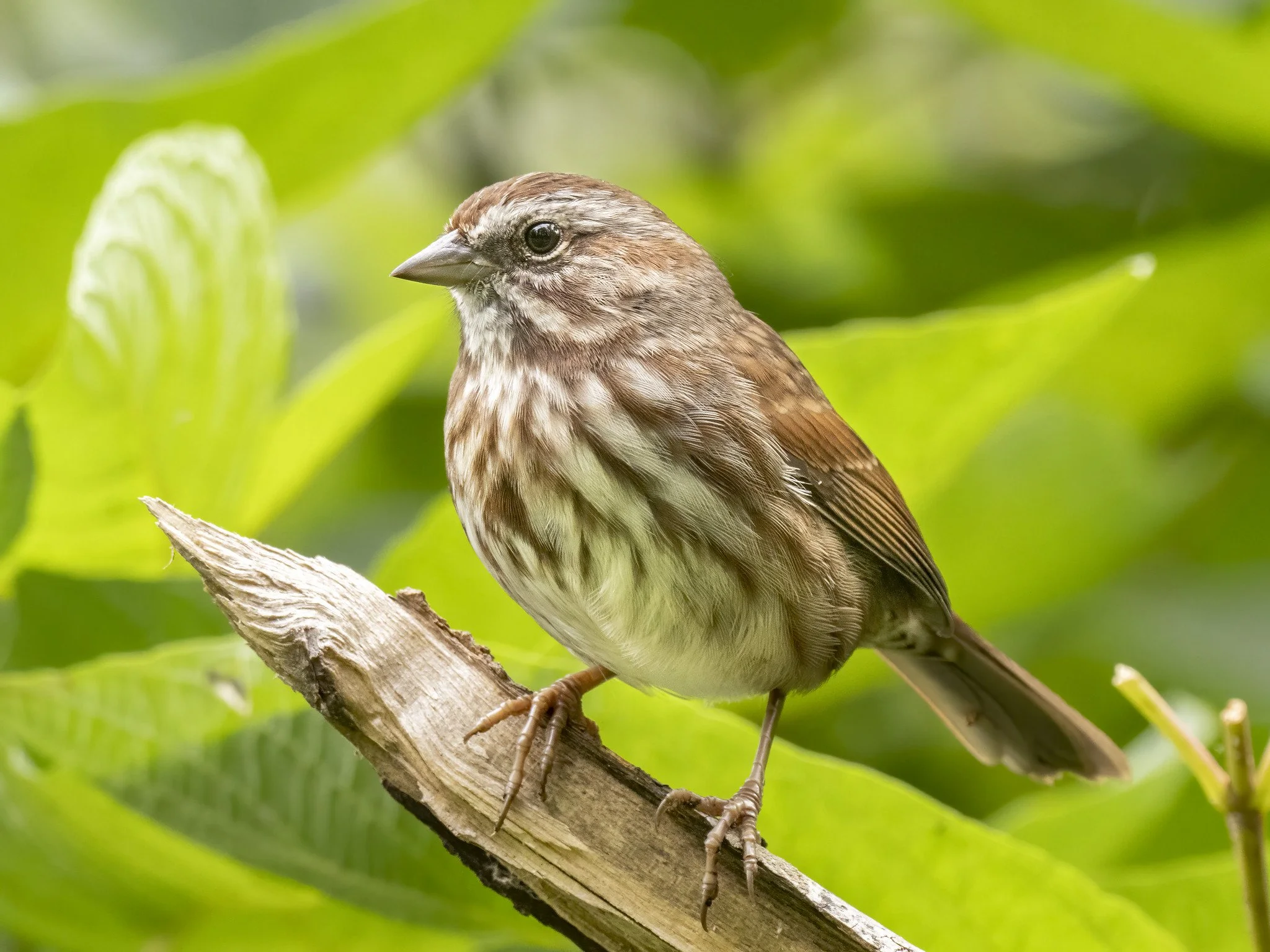
Song Sparrow © Mick Thompson
The Marymoor project was part of an AP (Advanced Placement) research on song sparrow (Melospiza melodia) vocalizations. Eastside Audubon helped negotiate with King County’s Department of Natural Resources and Parks to secure permission for the project. Cornell Lab of Ornithology provided the recording hardware — a SwiftOne autonomous recording unit that Prabhu purchased from the K. Lisa Yang Center for Conservation Bioacoustics.
Over eight weeks from January through March, the device recorded over 23,000 minutes of audio along the trail. Rather than sort through all of it by hand, Prabhu used machine learning to do the heavy lifting. He first ran the recordings through BirdNET, an open-source bird identification algorithm, to pull out 376 clips where song sparrows were vocalizing. He then converted those clips into spectrograms and fed them into an unsupervised clustering algorithm — a type of AI that groups similar sounds together without being told in advance what to look for.
The algorithm identified 27 distinct vocalization types: 5 song types and 22 call types. When Prabhu checked a sample by ear, the computer’s groupings matched his own at over 95% accuracy. The small number of song types suggests that Marymoor’s wintering sparrows share a fairly uniform vocal culture — they’re mostly singing the same few songs.
The timing data was interesting too. Songs peaked around 10 a.m. and faded by early afternoon, while calls surged in the late afternoon. Prabhu suggests suburban noise may play a role, suppressing the longer, more complex songs later in the day.
The project demonstrates that affordable passive recording equipment paired with modern machine learning can reveal meaningful patterns in bird vocal behavior — no banding or capture required. Prabhu hopes future work could deploy multiple recorders across parks to map how song sparrow dialects vary across the Eastside and track how they change over seasons.
Vidhur Prabhu is an avid birder and a senior at the International Community School in Kirkland
“What surprised me the most about the data was how relatively homogenous it was,” Prabhu explains. “I expected at least a few more songs to show up, especially since it's been well documented that these sparrows can store more than 10 different songs each. However, this does make sense: there actually is evidence in other species that songbird brains shrink and certain species lose the ability to sing during the winter.”
Despite the demands of completing high school, Prabhu is working on other science projects. He is using community data to explore how sparrow dialects differ across populations and whether machine learning can identify a song's population of origin. “I hope that, in uncovering these dialects, we can appreciate the complexity of birdsong and the complexity of the natural environment shaped around us,” he says.
Marymoor Park administrator Justin Camputaro was impressed with Prabhu’s work. “King County Parks is thrilled to support our Eastside Audubon Society community partners, and Prabhu’s senior research project specifically, as they explored methods for better understanding our Marymoor Park New World sparrows,” he says. “We look forward to learning more about our resident songbirds through ongoing study.”
For more information, Vidhur Prabhu’s full research paper: “Evaluating Vocal Variety in a Suburban Resident Population of Melospiza melodia: Machine Learning as a Means to Survey Songbird Populations.”
