EAS Offers College Scholarships

EAS Offers College Scholarships

Do you know a senior in high school who meets our criteria for a college scholarship?

Our Education Department offers a $5,000.00 award to a senior in our area (School Districts: Northshore, Lake Washington, Bellevue, Issaquah, Snoqualmie Valley, Riverview). The criteria include the following: keen interest in the environment/nature; involvement in extra-curricular activities based on this interest; college plans; teacher or counselor recommendation. Applications are due by the end of March. The application can be found on our website here.

If you have questions, please contact Mary Britton-Simmons at marybs98272@gmail.com.

Photo of the Month

Gary Luhm and Jim Avery are the Latest Eastside Audubon Photographers of the Month

Gary Luhm and Jim Avery are the latest members of the Eastside Audubon Photography Group to be honored for their work.

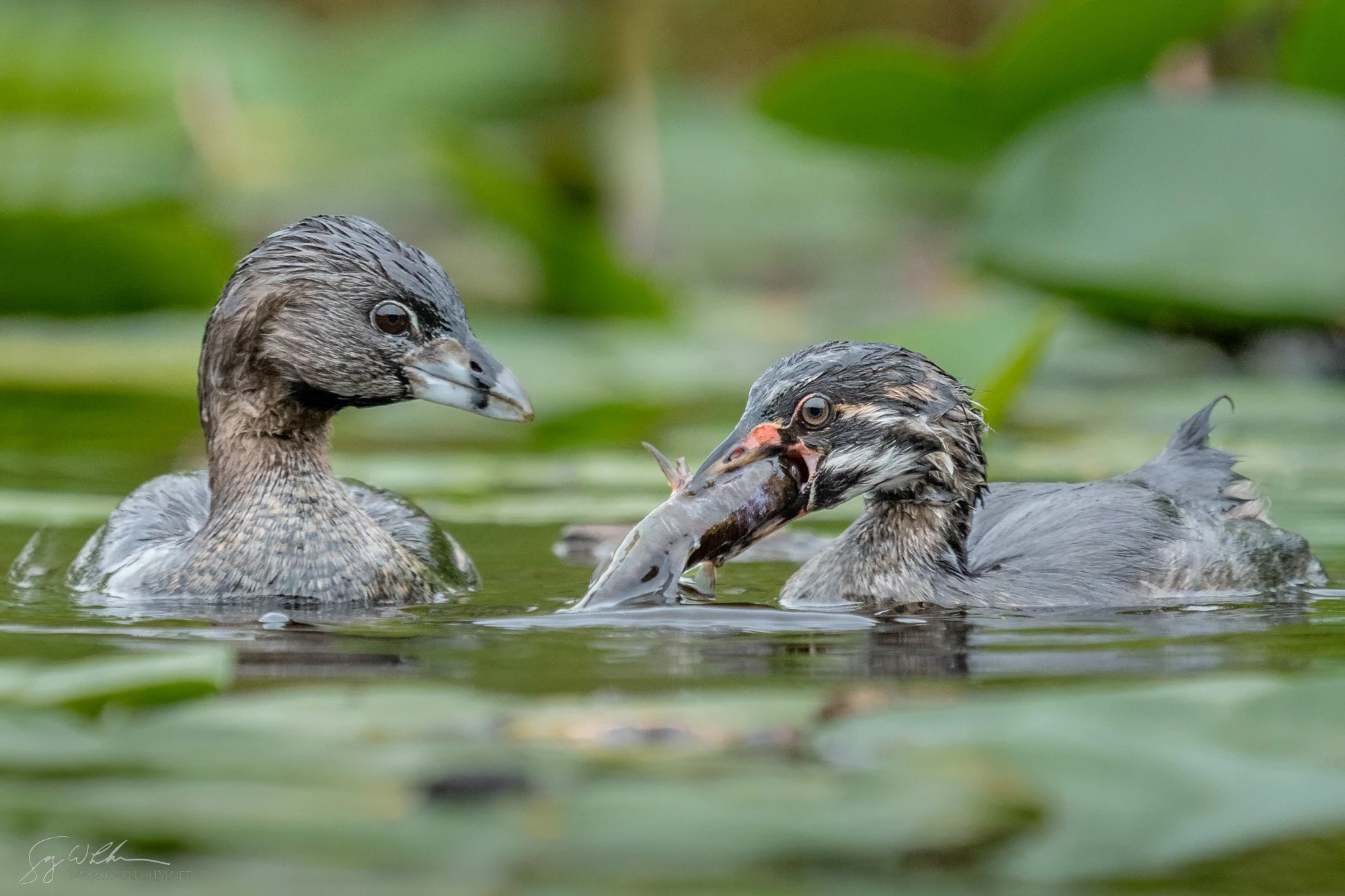
Pied-billed Grebe by Gary Luhm

Gary Luhm, a long-time member of the group, was named Photographer of the Month in September for a series of Pied-billed Grebe photos shot from his kayak.

Luhm, an expert kayaker, has birded while paddling in environments as varied as Alaska and Baja, Mexico.  The grebe images were shot on Union Bay in Seattle.

“All summer I'd been observing this Pied-billed Grebe family near Foster Island in Seattle, both by kayak and from shore,” he says.  “This was the parents’ second successful brood, which at the time had three one-month-old chicks. I was parked close by in a kayak when I was alerted by the sound of begging chicks and then saw a parent approach with a catfish. A youngster grabbed it, had difficulty swallowing it, and several times the adult snatched the fish back, crushed the skull, and eventually broke its neck. All the while I stayed low by resting the camera lens on the kayak deck and shot short bursts of the action.”

Pied-billed Grebe by Gary Luhm

Gary’s love of bird photography started in the 1990s at about the same time he took up kayaking.  “It started with trips to locations like Tongue Point, where the Harlequin Duck became my spark bird. I took up sea kayaking in 1992. In 2001, I started shooting with a 500 mm f/4  lens from a kayak.  Together, the kayak and big lens confer a wonderful low-angle bokeh.”

To see more of Gary's work, including dozens of photos and kayak tips, go to his website at www.garyluhm.net 

Photo details 

All photos were shot on a Sony A7 IV camera with the following settings:

Lens 100-400 mm | 1/400 of a second at f/5.6 | ISO 1600

Pied-billed Grebe by Gary Luhm


Jim Avery, a new member of the Eastside Audubon Photography Group, was named Photographer of the Month for a series of photos of a Golden Crown Kinglet. 

The shot was taken at Juanita Bay near the bottom of the hill sloping down from the parking lot at 98th and Forbes Creek.

Photo details 

Shot on a Sony Alpha 1 camera with the following settings:

Lens 600  mm | 1/2000 of a second at f/8 | ISO 125


About the Eastside Audubon Photograph of the Month Award 

The Photo of the Month award was instituted to recognize the work of the Photo Group Members. The group members meet monthly to show their latest photos and videos as well as share their knowledge of photography and wildlife. To attend the meetings, please join the group’s announcement list.

Register for the Christmas Bird Count

Register for the Christmas Bird Count, Saturday, December 17

Written by Andy McCormick

Registration for the 2022 Eastside Audubon CBC is open and there are still openings for volunteers to join on some CBC teams and feeder watching. Go to https://www.eastsideaudubon.org/christmas-bird-count to become a feeder watcher, join a field team, and join the Zoom celebration. We will have 15 field teams this year. 

ACCEPTING VOLUNTEERS AGAIN

For the past two years under COVID-19 pandemic conditions, Eastside Audubon has conducted the Christmas Bird Count (CBC) with very small teams of one or two people. We were able to maintain continuity in our data collection, which was important, but we missed having full teams in the field. Now, we are resuming having more volunteers join birding teams for this year’s Christmas Bird Count Day on Saturday, December 17.

The CBC is the world’s largest and longest-running community science data collection project. The 2022-2023 count period from December 14 to January 5 marks the 123rd CBC sponsored by the National Audubon Society. It will be Eastside Audubon’s 39th CBC. 

JOIN THE COUNT FOR FUN AND SCIENCE

The EAS CBC is an all-volunteer endeavor and we have three ways for you to participate. Our chapter has 15 teams being led by experienced birders who are accepting 3-5 volunteer participants. We also support at-home feeder watchers who count birds at their home feeder or other location within the 25-mile diameter circle centered on Beaver Lake in Sammamish. Everyone, whether birding or not,  is invited to join the Zoom celebration after the count. 

FOLLOWING COVID-19 PROTOCOL

Eastside Audubon wants to have more people involved in the CBC, but we also want to be careful to protect everyone from possible spikes in COVID-19 and flu infections. We will keep the field teams to 4-6 participants, and we will require wearing of masks while driving in a car for vaccinated people. We are going to postpone the after-count dinner for one more year and will host a Zoom celebration online.  

Whether you participate by joining a field team, watching your feeder at home, or sharing in the experience of the day via Zoom, you can register for the event you want to join here. Registration closes on Dec. 10. 

End of Year Letter 2022

End of Year Letter 2022

By Lori Danielson

Dear Friend,

Red-breasted Nuthatch by Mick Thompson

My time as a member of Eastside Audubon has given me a new appreciation of the birds around us. I first joined to simply learn how to better identify them, but I've gained so much more. Birds amaze me with their beauty, their presence in our neighborhoods, parks and natural areas, the long migrations that some make twice a year, and their unique behaviors for finding food and raising young. Birds can teach us so much about the world and our impacts on the environment.

I've also come to realize that it's very important that we share our love of birds with as many other people as possible, whether it's with politicians in order to shape policy that will benefit birds and people, or with those who haven't had the opportunity to experience the joy of birds firsthand. That's why our chapter is starting the effort to make Eastside Audubon activities more welcoming and accessible to people who perhaps haven't previously thought of connecting with Audubon or learning about birds.

During the pandemic our Board worked with a National Audubon Society consultant to learn about implementing concepts of equity, diversity, inclusion and belonging to our organization. With that knowledge, we created an Equity, Diversity, Inclusion and Belonging Committee and Board chair position. Two high school students were added to the Board as youth members. To make our meetings more accessible we’re using closed captioning in our online meetings. We are reaching out to new followers with our new high school social media intern. We’ve partnered with the Snoqualmie Tribe and Youth in Focus to help folks learn about responsible recreation on public and tribal lands. And we hosted our first LGBQTIA+ birding trip at Marymoor Park. We’re planning on making our activities and events welcoming spaces where everyone belongs!

Mandarin Duck by Margaret Larkin

Eastside Audubon has been sharing our passion for birds for 42 years with our friends, neighbors, family, and community. We’re continuing our education programs with local schools, field trips, online classes and program night lectures. Our conservation and advocacy programs build broad support for actions to help bird populations recover and preserve the habitats they need to thrive.

We depend on your support, so please make your annual donation by the end of the year. In 2023 we’re focusing on bringing the joy of birding to all of Eastside Audubon’s empowering education programs, committed advocacy efforts, and expert on-the-ground conservation initiatives. We all belong together to learn about and protect birds and the places they need. Please join us!

With gratitude,

Lori Danielson
Board President


PS. Make a gift to Eastside Audubon before midnight on December 31st to be an advocate for birds. Visit eastsideaudubon.org/donate or mail your donation.

The Bird Gallery Has Been Updated

The Bird Gallery Has Been Updated

The Eastside Audubon Bird Gallery is a repository of 27 years of Bird of the Month columns written by Hugh Jennings and Andy McCormick. To date there are 206 articles and photos of your favorite birds from Washington sprinkled with a few from other places. We have updated the gallery by reorganizing the bird categories and included more photos from the EAS Photo Group. 

The new gallery has been divided into 12 categories to help you find birds more easily. Birds are not in traditional taxonomic order but are grouped by the types of birds you might see together or by habitat. Here are the categories with the number of birds in each category in parentheses: Shorebirds (26), Birds of Prey (25), Hummingbirds and Doves (7), Grassland Birds (7), Woodpeckers and Jays (11), Finches (7), Sparrows (14), Seabirds and Gulls (23), Marsh Birds (15), Waterfowl (26), Woodland Birds (26), and Warblers and Flycatchers (19). 

The Bird of the Month column has been a popular feature in the chapter’s monthly newsletter The Corvid Crier since 1995. Begun by Hugh Jennings, who wrote articles until early 2009, the regular column has been written since then by Andy McCormick. Both writers have had a good knowledge of birds and enjoy passing on their experience in an engaging manner with identification tips, natural history, and conservation information about each bird species. Almost all of the birds can be found in Washington, but occasionally a rare or newsworthy bird is featured.

The Bird Gallery will continue to grow as each Bird of the Month column is added to the collection. The gallery is available to anyone who visits the website here. Check it out and enjoy reading about the birds of our wonderful State of Washington. 

Thanks to Hugh and Andy for their writing, Tyler Hartje for improving the website, Penelope Kipps and other previous editors of The Corvid Crier, and Amanda Leon, the chapter’s current Executive Director for keeping it all organized. 

Youth Education Committee Fall Updates

Youth Education Committee Fall Updates

Summer has slowly slipped away and so, the Youth Education Committee (YEC) is gearing up for another busy fall. Check out our website and schedule your event.

Do you want a classroom presentation on birds? Great! On what particular aspect do you want the presenter to focus: introducing students to birds, backyard birds, beaks? Or are your students more advanced and need to learn about migration and habitat? Are they interested in owls? What particular workshop will appeal to them?

Are they ready for a walk in a lovely park to see and identify birds? Then, you might be interested in one of our walks with an experienced guide to help you identify birds that you see on land and on the water. You will see a wide variety of birds: on land such as the Black-capped Chickadee, the Northern Flicker, and the Red-breasted Nuthatch. On the lake, look for the Common Goldeneye, the Bufflehead, and the Canada Goose. You might even be lucky enough to spot a Bald Eagle winging its way across the lake. 

Whatever your interest, we are there to help your students learn. Check out our website and give us a call at 425-894-0100.

Preserving Greenspace in King County

Preserving Greenspace in King County

King County Proposition 1, which would restore funding for the Conservation Futures program, will be on the ballot Nov 8, 2022.  This program is one of the most important mechanisms for conserving undeveloped land within the county.  The EAS Board of Directors will be discussing whether to formally endorse Proposition 1 at the September board meeting.  The following offers background information for those interested.

King County has a long history of preserving and protecting our natural resources.  Land conservation in King County—and 13 other counties—is largely funded by the Conservation Futures Program that the state created 50 years ago. However, the Conservation Futures program is currently generating only 50% of the original revenue limiting the capacity to conserve open space.

Over the past 40 years, King County has protected more than 100,00 acres of greenspace including waterways, forests, farmland (through the purchase of development rights), trails, in-holdings within public lands, and urban parks.  Applications from the county, cities, or conservation groups are made to the Conservation Futures Advisory Board which assesses the requests and makes recommendations to the King County Executive. Generally, municipalities provide 50% of the funding with the remaining 50% coming from Conservation Futures grants.  Examples of land preserved through Conservation Futures include Cougar Mountain, Bear Creek Waterways, Issaquah Creek Greenway, Evans Creek, and EasTrail.

With all this success, why do we need Proposition 1?  The King County Land Conservation Initiative (LCI), a collaborative effort between the county, businesses, farmers, and environmental groups to preserve green space, has currently, identified 65,000 additional acres of undeveloped land with the goal of preserving them within the next 30 years.  Continued development and increasing property values have made obtaining these natural areas for the public good more difficult.  While property values have been increasing, funds from the property tax levy used for preserving land through acquisitions has been shrinking. 

In 2001, the legislature capped property tax increases at 1%/year.  This has brought down the Conservation Futures funding from 6.25 cents/ $1,000 to 3.12 cents in 2022 and will be only 2.84 cents in 2023.  This halving of the funding has occurred while property values have increased which has significantly limited the ability to purchase land for conservation.  Conservation Futures funding has simply not kept pace with property values of the remaining open spaces.

What does Proposition 1 do?  If passed, Prop 1 will restore Conservation Futures funding back to the original $.0625 cents per $1,000 assessed property value.  Cost for the average homeowner would be about $2 more per month.  This $2 per month would double our ability to protect the most important open spaces within a single generation. 

Why protect our remaining green space?  Besides providing habitat for birds, protecting our remaining greenspace confronts climate change by protecting mature forests, adds equitable access to greenspace in underserved areas, preserves salmon habitat, protects more homes, farms, and roads from flooding, provides more land for recreation, and protects farmland from development.

How We're Connected: Forests, Palm Oil, and You

How We're Connected: Forests, Palm Oil, and You

As detailed in Part One, growth of large-scale oil palm plantations starting in the 1990’s showed immediate and obvious negative effects. Outcry from NGOs, environmental groups, and consumers over deforestation and human rights abuses led to the formation of the Roundtable on Sustainable Palm Oil (RSPO). Starting in 2008, the RSPO developed a set of criteria which producers could voluntarily apply in order to gain an RSPO sustainable palm oil certification.

Photo of the Month: August

Don and Margaret Larkin are Selected as Photographers of the Month in August

Don and Margaret Larkin were named the Eastside Audubon Society photographers of the month for the second time in August for a series of owl photos. The couple won the EAS Photography Group award in May

You can see more of their work on SmugMug and Instagram.

Here is the story behind their owl photographs. 


A Barred Owl Family 

By Don and Margaret Larkin 

Barred Owl #2 – Margaret Larkin, 450 mm, 1/30 sec, F 8, ISO 2500 

In June, during our evening walk just before sunset, my wife Margaret and I were excited to hear a faint and familiar sound coming from the woods.  This sound was a lot different from the usual chickadee and song sparrow calls that we normally hear.  This was a soft hissing sound that could only come from a juvenile owl calling out to be fed by its parents.  We spotted the owl and soon discovered it had a sibling nearby.  Both parents were busy hunting for food while the owlets were practicing their flying skills and exploring the woods.  Over the next couple of months, we were able to sit quietly and watch the owl family go about their evening routine.  As the owlets grew, they became more confident and courageous.  They appeared to be just as curious about us as we were about them.  The parent owls didn’t seem to worry, and they were calm and relaxed while we were there.  

What is it about owls that make even non-birders stop and gaze at them with amazement?  Is it because we remember reading about them in children’s books or seeing them in movies as the wisest of all birds?  Since Greek times, owls have been considered wise because of their heightened senses and their association with the night.  Their night vision and superior hearing abilities allow them to easily catch prey and protect themselves from danger in the dark. They are mysterious birds who fly without making a sound, and whose presence can only be heard at night by their familiar hooting calls.  Owls are also difficult to see during the day because their feathers blend so well with their surroundings.       

Barred Owl #3- Margaret Larkin, 550 mm, 1/40 sec, f 6.3, ISO 2500  

We are also fascinated with owls because they seem to have some human “personality”.  Sometimes we see an owl’s behavior or body language and can’t help but imagine that they think the same way we do.  Over the years, Margaret and I have focused a lot of our photographic attention on owls because we see them demonstrate behavior that we admire in humans, such as strength, patience, skill, caring, and family commitment.  Perhaps it is these qualities that make owls so fascinating and wise.        

 The series of photos show the parent owls relaxing and showing affection, and one owlet waiting for the parents to feed him.   

Barred Owl #1 – Don Larkin,  500 mm, 1/30 sec, F 6.7, ISO 2500

Barred Owl #4 – Don Larkin,  500 mm,  1/45 sec, F 5.6, ISO 8000 


About the Eastside Audubon Photograph of the Month Award 

The Photo of the Month award was instituted to recognize the work of the Photo Group Members. The group members meet monthly to show their latest photos and videos as well as share their knowledge of photography and wildlife. To attend the meetings, please join the group’s announcement list.

Photo of the Month: July

Jay Galvin is the June Photographer of the Month

Canon 5D Mark IV | Tamron 150-600 mm lens | 1 /640.of a second at f/8 | ISO 1600

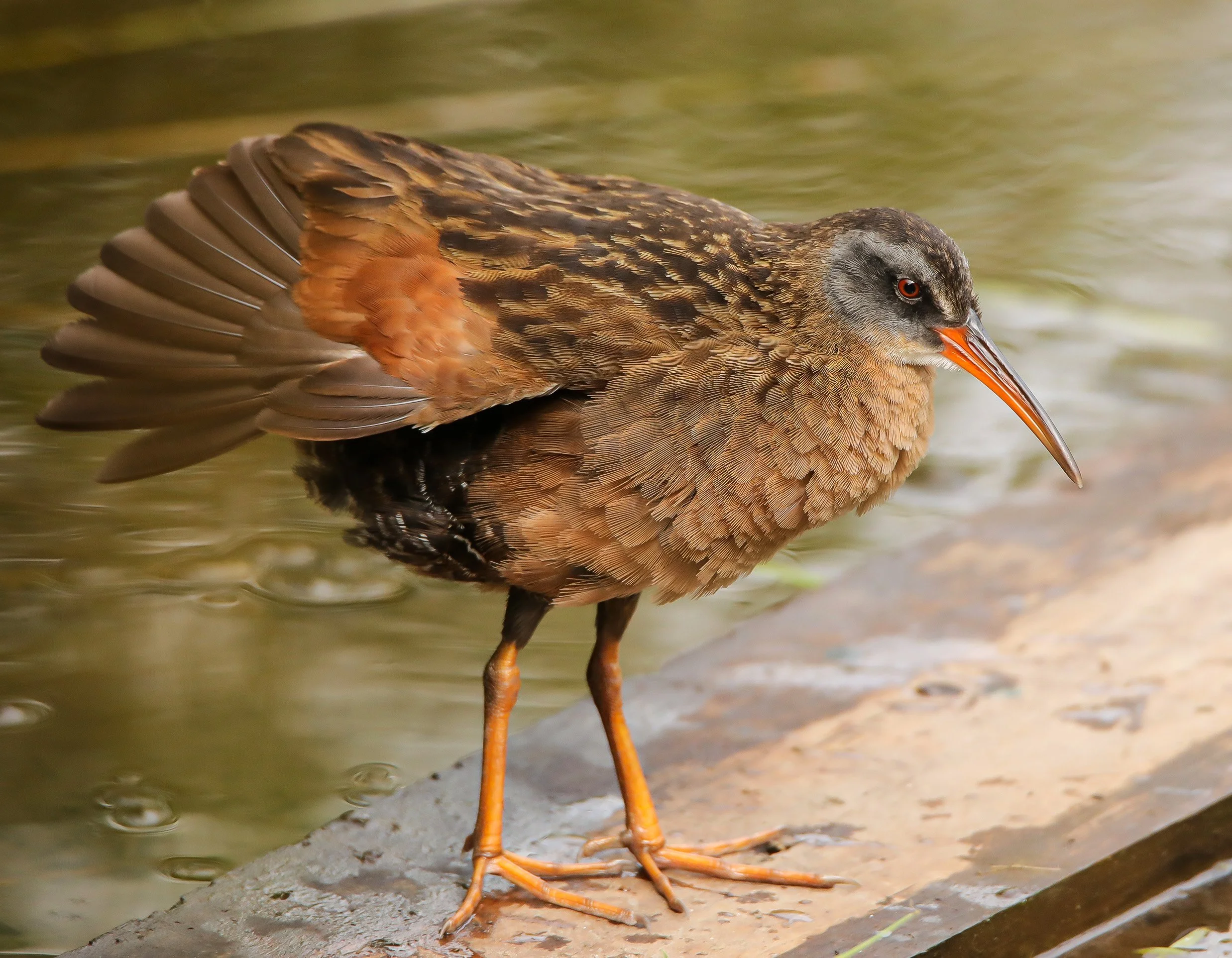
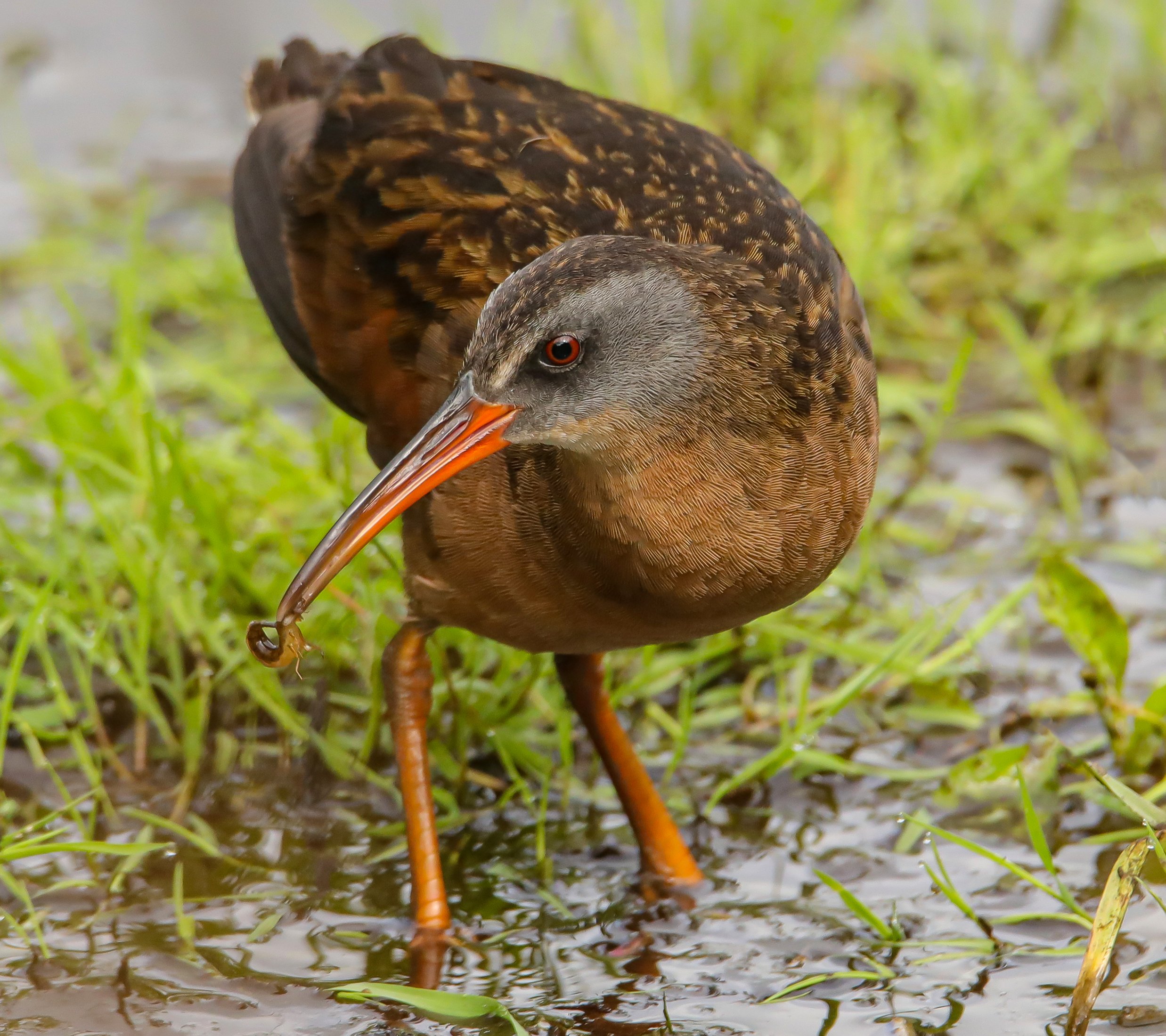
Jay Galvin, a long-time member of the Eastside Audubon Society photography group, was selected as the Photographer of the Month for his series of photos of a Virginia Rail he shot at Flaming Geyser State Park.

“The Virginia Rail that came out of the reeds in front of me and proceeded to preen itself for a couple of minutes,” he says. “Flaming Geyser State Park is a great marsh for photographing all kinds of avians all year long. The bird knew I was watching it, but it seemed not to care as I clicked away with my Canon 5D Mark IV!”

Jay started photographing birds when he purchased in 2005 his first digital camera, a 12.8 megapixel Canon 5D. He gravitated towards bird photography as they are close-at-hand and often willing subjects.

More of Jay’s work is available on Facebook.

Canon 5D Mark IV | Tamron 150-600 mm lens | 1 /800.of a second at f/8 | ISO 1600

About the Eastside Audubon Photograph of the Month Award 

The Photo of the Month award was instituted to recognize the work of the Photo Group Members. The group members meet monthly to show their latest photos and videos as well as share their knowledge of photography and wildlife. To attend the meeting, please join the group’s announcement list.

Canon 5D Mark IV | Tamron 150-600 mm lens | 1 /800.of a second at f/8 | ISO 1600