

Bird of the Month: Mallard
Written by Andy McCormick

Andy McCormick, 2024 Audubon Washington Helen Engle Volunteer of the Year
Often underappreciated because it is so common, the Mallard is present throughout the Northern Hemisphere and known by sight by millions of people.
The Mallard for most people is the very embodiment of a “duck” (Drilling et al). The male Mallard’s distinctive green head is separated from its chestnut brown chest by a white neck ring. The yellow bill is prominent and stays yellow in late summer when the Mallard has the appearance of a female when in eclipse plumage. The legs and feet of both male and female are orange and in the secondary feathers both sexes share bright blue speculums bordered front and back in white. The rump is black and the tail feathers of the male curl forward unlike those of any other duck.
The female is a plain, mottled brown overall. Its bill is a dull orange and has a black saddle across it. This bill marking is a helpful field mark for separating the females of Mallard and Gadwall. The female Gadwall (A. strepeva) has a black bill with orange along the sides. Photos, videos, and vocalizations of the Mallard can be accessed at the Macaulay Library.
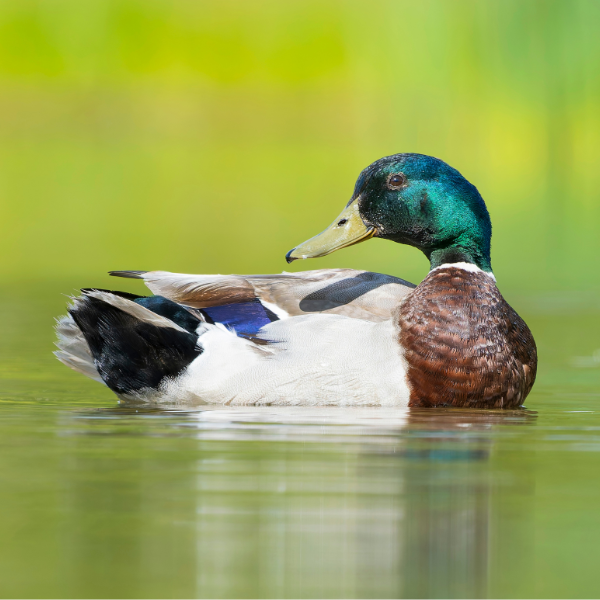
Mallard
Scientific Name: Anas platyrhynchos
Length: 23”
Wingspan: 35”
Weight: 2.4 lbs (1,100 g)
AOU Alpha Code: MALL
DISTRIBUTION AND BREEDING
The Mallard is ubiquitous worldwide in the Northern Hemisphere. It breeds from the subarctic to the subtropic regions and will nest not only in large gatherings in the prairie potholes but also in smaller groups or solo in almost any environment where there is water including city parks, wayside streams, and marshes. Many populations of Mallards are sedentary, breeding and wintering in the same general area. Northern birds will remain in place until water freezes and only then will they move south in a short or medium distance migration. They return to their breeding area as soon as waterways are free of ice.
Female Mallards build a shallow bowl-shaped nest of gathered plant material and line it with down. Usually, 7-10 whitish to olive-colored eggs are deposited and incubated by the female for about four weeks. The young leave the nest a day after hatching and are led to water by the female (Kaufman). The scene of a mother duck followed by 8-10 ducklings is immortalized in the wonderful children’s book Make Way for Ducklings (Robert McCloskey, 1941) and in a bronze sculpture installed in the Boston Public Garden in 1987. In Kirkland, WA in 2025, I saw such a parade walking on the I-405 freeway holding up traffic in the slow lane.
CONSERVATION AND MANAGEMENT
The Mallard has been hunted for food for hundreds of years and still manages to sustain a large world population, In North America the 2018 surveys in Alaska, Canada and the north-central United States combined with the Eastern Survey Region for a total of 10.35 million Mallards. The combined European and Asian population totaled 9,000,000 more with another 3,000,000 in New Zealand. The trend for Mallards in North America is stable or increasing with some slight decreases in east-central Europe. Populations are naturally regulated with increases in rainy seasons and decreases in drought years (Drilling et al).
A NOTE ON TAXONOMY
The Mallard (Anas platyrynchos) is part of a superspecies complex that includes American Black Duck (A. rubripes) of northeastern North America, Mottled Duck (A. fulvigula) of southeastern North America, the Hawaiian Duck (A. wyvilliana), the Philippine Duck (A. luxonica), and the Spot-billed Ducks (A. peocilorhyncha). A seventh duck in this group is the Mexican Duck (A. diazi) which was recently split from Mallard and raised to full species status. Studies of mitochondrial DNA sequence data suggest that the Mallard evolved in Africa and radiated from there hybridizing with other forms resulting in the larger group of related ducks (Drilling et al).
Photo credit: Mick Thompson
References available upon request from amccormick@eastsideaudubon.org.