
Bird of the Month: Common Loon
Written by Andy McCormick

Andy McCormick, 2024 Audubon Washington Helen Engle Volunteer of the Year
This month we are presenting an archive edition of the Bird of the Month. This essay on the Common Loon, which first published in February 2009, is one of my favorite columns. The Common Loon has a wonderful wild call, a wail really, and it is a special being in the Ojibwe history and culture. The Common Loon was selected by the American Birding Association as the Bird of the Year for 2025. I hope you enjoy getting reacquainted with this wonderful bird.
-Andy McCormick
The “song of the loon” once heard will never be forgotten. Piercing the evening across a lake in northern North America the male loon defends his territory with yodels that can be heard up to 16 km away. While only the male yodels, both the male and female use a tremolo and a wail and a combination tremolo-wail. The loon is integral to Ojibwa mythology and they say that in creation the Sun threw light on the shadow creating the striking markings on the loon. In Ojibwa mahng means both loon and brave.
common loon
Scientific Name: Gavia immer
Length: 32”
Wingspan: 46”
Weight: 9 lbs (144 oz)
AOU Alpha Code: COLO
TAXONOMY
Scientific taxonomy places five species of loon in the genus Gavia and all of them are in North America. Gavia is Latin for a seabird and immer is from the Icelandic himbrimi, their name for the Great Northern Diver, as the bird is known in Europe. Loon is a corruption of the Shetland loom, their name for a guillemot, another diving bird (Holloway).
PLUMAGE AND DISTRIBUTION
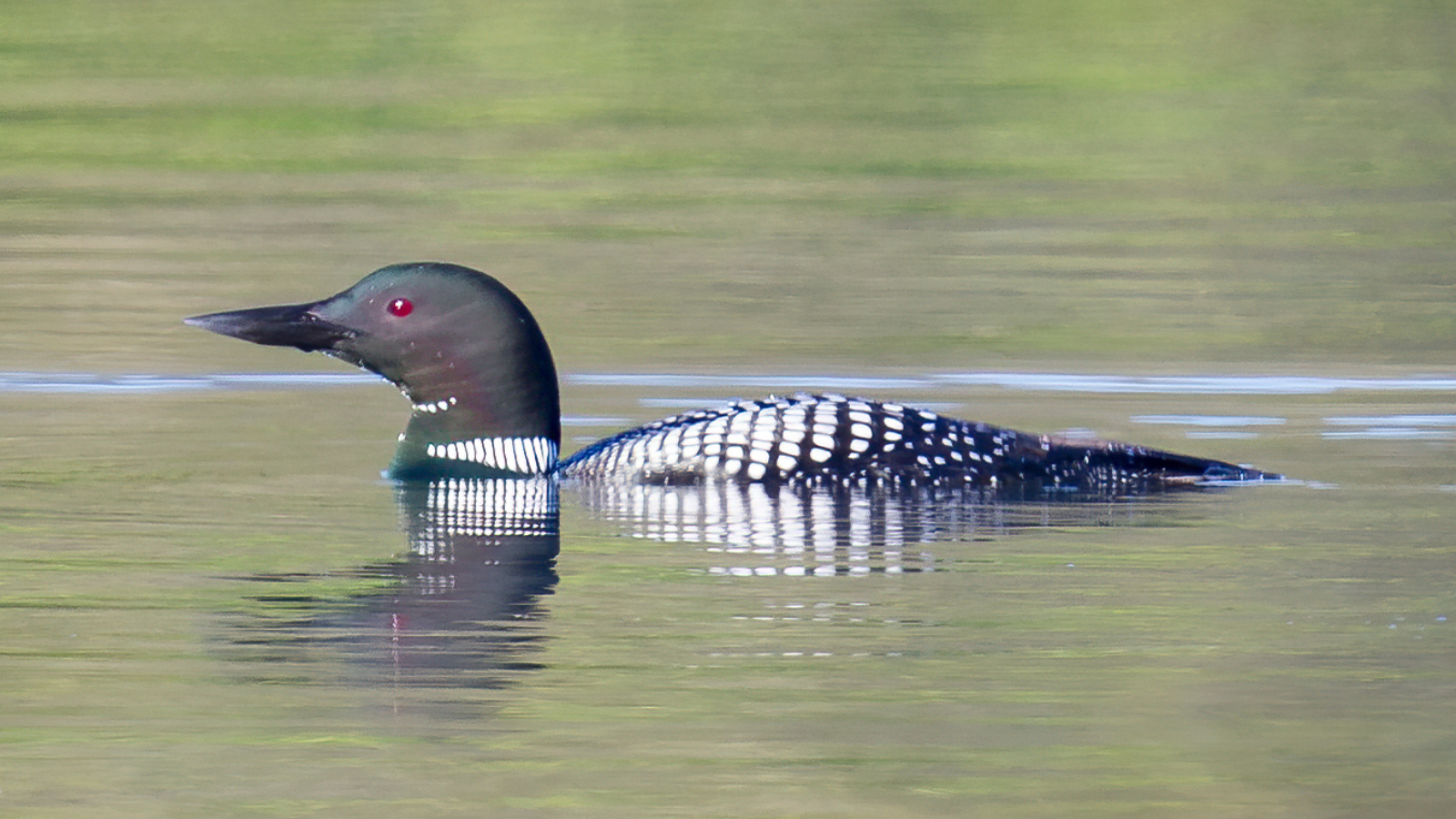
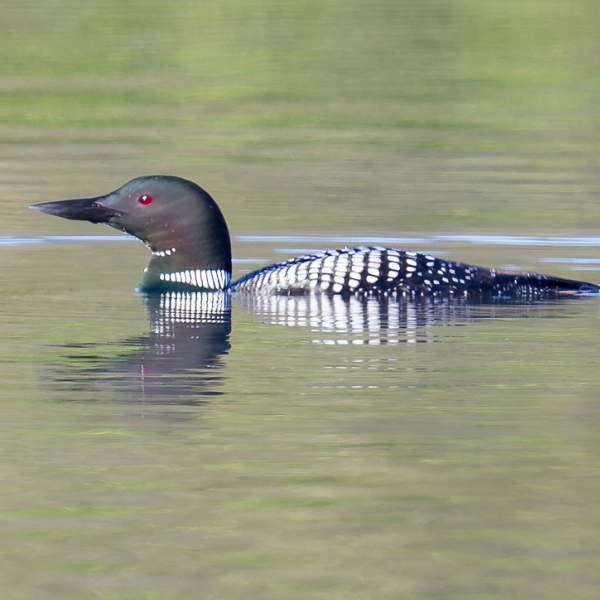
Common Loons are very large aquatic birds which in breeding plumage have a greenish-glossed black head with a heavy, black bill, red eye and two horizontal white neck bands with vertical black stripes. The back has a checkerboard pattern of black and white. In Washington birds in breeding plumage are usually seen during spring migration from late March to early June. Although they breed on freshwater, loons winter primarily in marine waters from September until March. Adult birds arrive first and juveniles, which stay on the breeding grounds until almost the first frost, follow. Wintering loons have gray heads with white throat and neck. The neck band is fainter and the back is more uniformly dark gray with faint checkering. In flight loons have a characteristic “humped-back” silhouette and long wings.
NESTING AND MATING
Loons mate for life. Males will become quite aggressive in defending their territory. Unless a lake is very large, it is likely to have only a single mated pair nesting on it. The nest is a mass of reeds, rushes, grasses and sticks and is built very close to the water sometimes on a muskrat house or a floating bog. Two brown-spotted olive colored eggs are often laid before the nest is finished. The young hatch in about a month and in one or two days swim with their parents or ride on the back of one of them. They are capable of flight in about 10 weeks. The population of Common Loons is quite stable in part due to successful conservation programs such as the Loon Ranger volunteers who monitor nests.
Mahn-go-taysee in the Ojibwa language means “thou art a loon-hearted one” and it is the finest compliment an Ojibwa can give. It praises the spirit of bravery in another person (Klein). In Ojibwa tradition and for all North Americans our loon heartedness can still provide a link to our origin and connection with nature.
Audio and video clips of the Common Loon can be found at this link on the Cornell Lab of Ornithology Web site.
THE COMMON LOON CALL IN MOVIES
This section has been added by newsletter editor Penelope Kipps.
A fun fact about the Common Loon’s call is that Hollywood absolutely loves it. Whether or not the setting actually makes sense, the loon’s eerie, wailing cry has become a go-to sound for creating a creepy, ominous mood in movies. You’ve almost certainly heard it before without realizing what it was. To the untrained ear, it’s synonymous with dark woods at night. The sound often isn’t accurate to the Common Loon’s real range or habitat. In Hollywood, atmosphere usually wins out over factual accuracy—much like how the call of a Red-tailed Hawk is famously used in place of an Eagle’s!
Photo credit: Mick Thompson
References available upon request from amccormick@eastsideaudubon.org.