
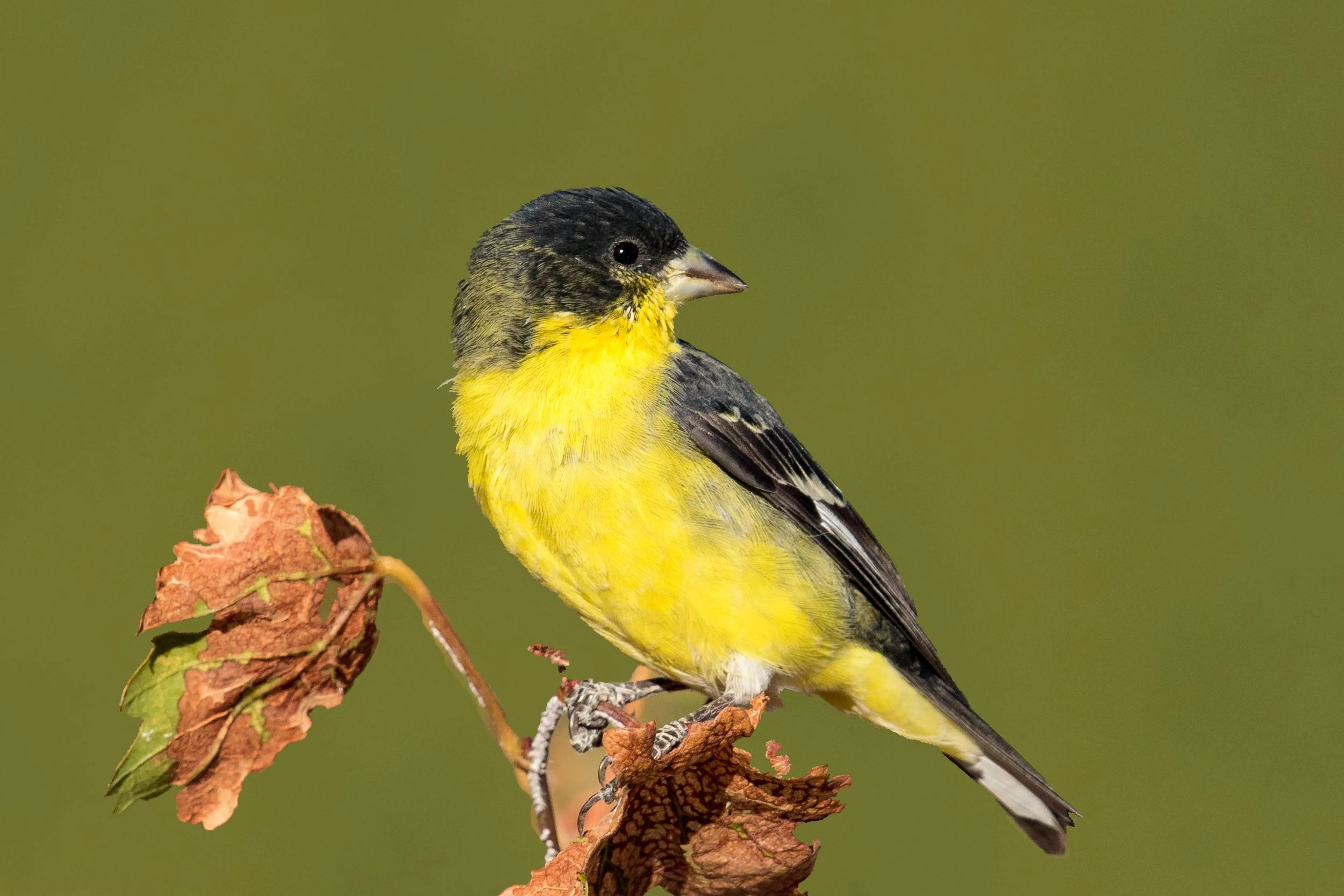
Bird of the Month: Lesser Goldfinch
Written by Andy McCormick

Andy McCormick, 2024 Audubon Washington Helen Engle Volunteer of the Year
The Lesser Goldfinch is expanding its range northward from the American southwest and is now nesting in Washington State.
The Lesser Goldfinch is a small, lively, and acrobatic bird which can balance on a tall blade of grass and feed upside down on a seed head. It forages in small flocks on its own or mixed with American Goldfinches and Pine Siskins. It is smaller than its more widespread relative the American Goldfinch, but its diminutive size is boosted by its constant singing and ability to mimic other birds. While flitting around it maintains an ongoing chatter of frequent communication with other feeding finches. This finch has subspecies with two color morphs: green-backed and black-backed.
The males of both forms are yellow on the chest and belly, and large white patches mark the black wings when open. The green-backed form has a black cap which contrasts with the green back. The black-backed form is entirely black from the head to tail. The female Lesser Goldfinches of both forms resemble the female and juvenile American Goldfinch but the light brown plumage on the back of the latter aids identification (Alderfer).
The species is considered nonmigratory and most populations of Lesser Goldfinch are resident in their regions. However, they are known for nomadism when in search of seed-bearing plants and they will leave high elevation locations during winter to find more favorable locations where seed plants are exposed.
Lesser goldfinch
Scientific Name: Spinus psaltria
Length: 4.5”
Wingspan: 8”
Weight: 33 oz (9.5 g)
AOU Alpha Code: LEGO
STATUS AND DISTRIBUTION
Arthur Cleveland Bent (1968) reports Lesser Goldfinch near Vancouver, WA and in western Oregon. More recent data gathered since the early 2000s reflect an increase in both the presence and abundance of Lesser Goldfinches, and by the second decade of this century a wave of these finches has spread across the state. In 2025 they were reported from the Puget Sound region with occasional individuals being observed as far north as Abbotsford, BC.
Although Lesser Goldfinch is resident in Washington only the green-backed plumage form has reached the state. The green-backed form is most common in Washington, Oregon, and California. East from there it mixes with the black-backed form which is the dominant subspecies from Texas south through Mexico to some locations in Venezuela, Columbia, Ecuador, and Peru.
Their wandering nature and ability to locate new sources of seeds due to the spread of weedy fields in urban areas have facilitated their range expansion into Washington (Maron et al 2025). A recent report describes typical behavior of Lesser Goldfinches in Pullman, WA feeding on Tansy and Common Dandelion and documents their presence at bird feeders (Maron 2025). Rising global temperatures may also aid their northward movement as the species favors warmer and drier environments.
VERSATILE NESTER
The Lesser Goldfinch will nest in a variety of habitats from valleys to high elevation and in most of these regions it prefers open areas near brush or riparian zones. Nests are often close to a water source as these birds require water to help digest the seeds they eat. Nesting begins with courtship flights by the male during which they display in a circular flight exposing the prominent white wing patches. The female constructs an open cup nest of grasses, other plant fibers, and strips of bark. Usually, 4-5 pale blue eggs are deposited. The female has sole responsibility for incubation which lasts 12 days (Kaufman), but both parents bring food to the young. Although the diet consists mostly of seeds, insects are included when available. The male supplements the diet by bringing predigested regurgitated seeds to the young (Aversa et al).
A NOTE ON TAXONOMY
Following a split from the genus Carduelis, Lesser Goldfinch is now placed in the genus Spinus which was resurrected from usage by the German naturalist Carl Ludwig Koch in 1816. He took the scientific name from the Eurasian siskin (Fringilla spinus) originally named by Linnaeus in 1758. There are 20 bird species in the genus Spinus. Along with Lesser Goldfinch, it includes the American Goldfinch and Lawrence’s Goldfinch of North America, the Eurasian Siskin, the Tibetan Serin, and an additional 15 Western Hemisphere species of finches and siskins. Carduelis now houses four European finches (Wikipedia).
Photo credit: Mick Thompson
References available upon request from amccormick@eastsideaudubon.org.