
Bird of the Month: Sharp-tailed Grouse
Written by Andy McCormick

Andy McCormick, 2024 Audubon Washington Helen Engle Volunteer of the Year
Most easily seen as it feeds in trees when snow covers the ground, the Sharp-tailed Grouse is sought after in Eastern Washington in winter.
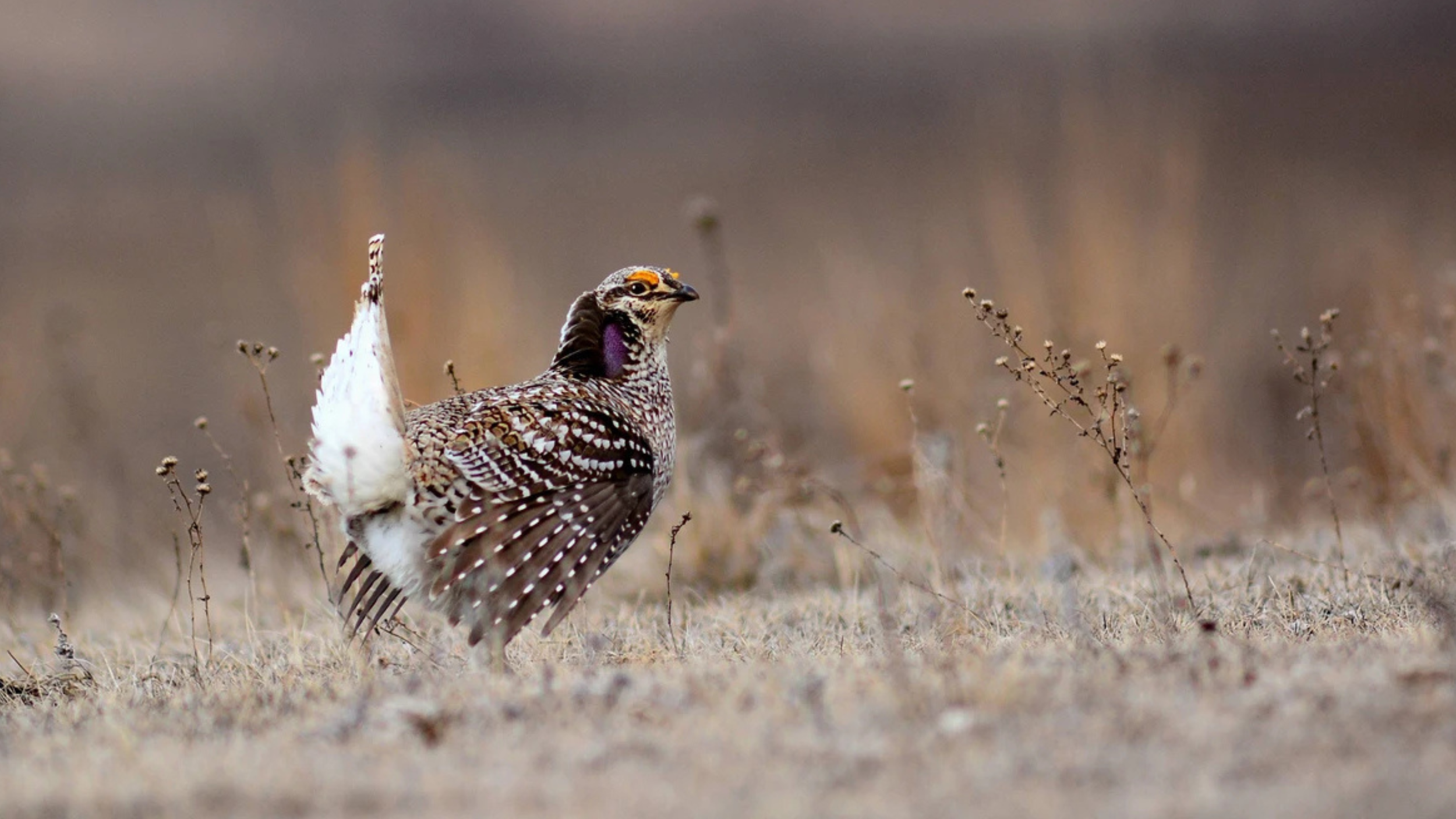
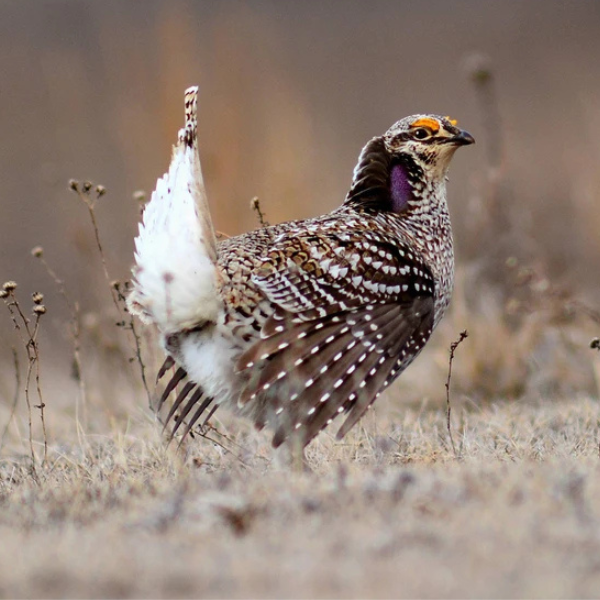
The Sharp-tailed Grouse is similar to the Greater and Lesser Prairie Chickens but prefers habitat of mixed grassland and sage country where trees are present. Its white belly and undertail coverts and chevron-shaped markings on the chest separates it from the barred underside of the prairie chickens. The Sharp-tailed Grouse’s legs are feathered and the bird features yellow combs over it eyes. The combs and purple air sacs at the throat are more prominent in the males, which are larger than the females. The tail of the Sharp-tailed Grouse is wide at the base but is elongated as it tapers to a point. The tail shows all white on the underside as it is raised during display.
Like prairie chickens, Sharp-tails perform a mating dance on a lek, the name given to a chosen location at a break in the grassland or sagebrush. The leks of grouse and prairie chickens are well-established among populations of these birds and are often used for decades during spring mating seasons. The males and females gather on the lek before dawn and perform a ritual that is centuries old. The males pass females as they move about the lek stopping occasionally to stomp their feet and dance in a circle as if to impress the females. While turning the males call and shake their tail feathers producing a rattle which accompanies their movements. Photos, videos of lekking behavior, and vocalizations of Sharp-tailed Grouse in Washington can be accessed at the Macaulay Library.
Sharp-tailed Grouse
Scientific Name: Tympanuchus phasianellus
Length: 17”
Wingspan: 25”
Weight: 1.9 lbs (880 g)
AOU Alpha Code: STGR
ONE OF OUR PRAIRIE CHICKENS
Sharp-tailed Grouse shares the genus Typanuchus, from the Greek tumpanon, a kettle drum, referencing the inflatable neck sacs which produce a drum-like boom during the mating dance of the male. The other two grouse in the genus are the Greater Prairie Chicken (T. cupido) and Lesser Prairie Chicken (T. pallidicinctus). The species epithet, phasianellus, describes a little pheasant. The female sharp-tailed resembles the female Ring-necked Pheasant but is smaller and has white feathers under its shorter tail.
The Sharp-tailed Grouse has a more northerly range than the other prairie chickens. It breeds in the north-central United States north to central Manitoba, Saskatchewan, and Alberta and in a separate range in central Alaska. Of particular concern the columbianus subspecies of Washington, British Columbia, and parts of Utah and Colorado is a declining population among the seven subspecies of Sharp-tailed Grouse (Floyd). The bird’s breeding range in Washington is confined to seven small locations on the Columbia Plateau.
NESTING AND BROODING
The female Sharp-tailed Grouse builds a nest by lining a depression in the ground with grass, leaves, and ferns. Usually, about a dozen eggs are deposited, however this number can range from 5 to 17. The olive-brown eggs are incubated by the female for a little over three weeks. Once hatched, the downy young are precocious and will follow the female to feeding areas, where they forage for seeds and buds, and insects as they are available. They begin to make short flights within one to two weeks (Kaufman).
CONSERVATION AND MANAGEMENT
Sharp-tailed Grouse are managed as game birds in 18 states. The annual harvest from 1962 to1973 was estimated in Nebraska from 91 to 706 grouse, and from 1945 to 1970 in South Dakota at 18,900 to 143,000 individuals. The breeding complex required for this species includes the area within a 2km radius of the lek. Suitable habitat of this size has become more difficult to maintain as rangeland is converted to agriculture and pine forests (Connelly, J. M. et al). This type of reduction in suitable breeding habitat is the primary threat to this grouse. While the overall population of Sharp-tailed Grouse is increasing over its larger territory, the Washington Department of Fish and Wildlife has listed the Columbian Sharp-tailed Grouse as endangered in the state (WDFW).
Photo credit: Rick Bohn / USFWS / Flickr (CC BY 2.0)
References available upon request from amccormick@eastsideaudubon.org.