
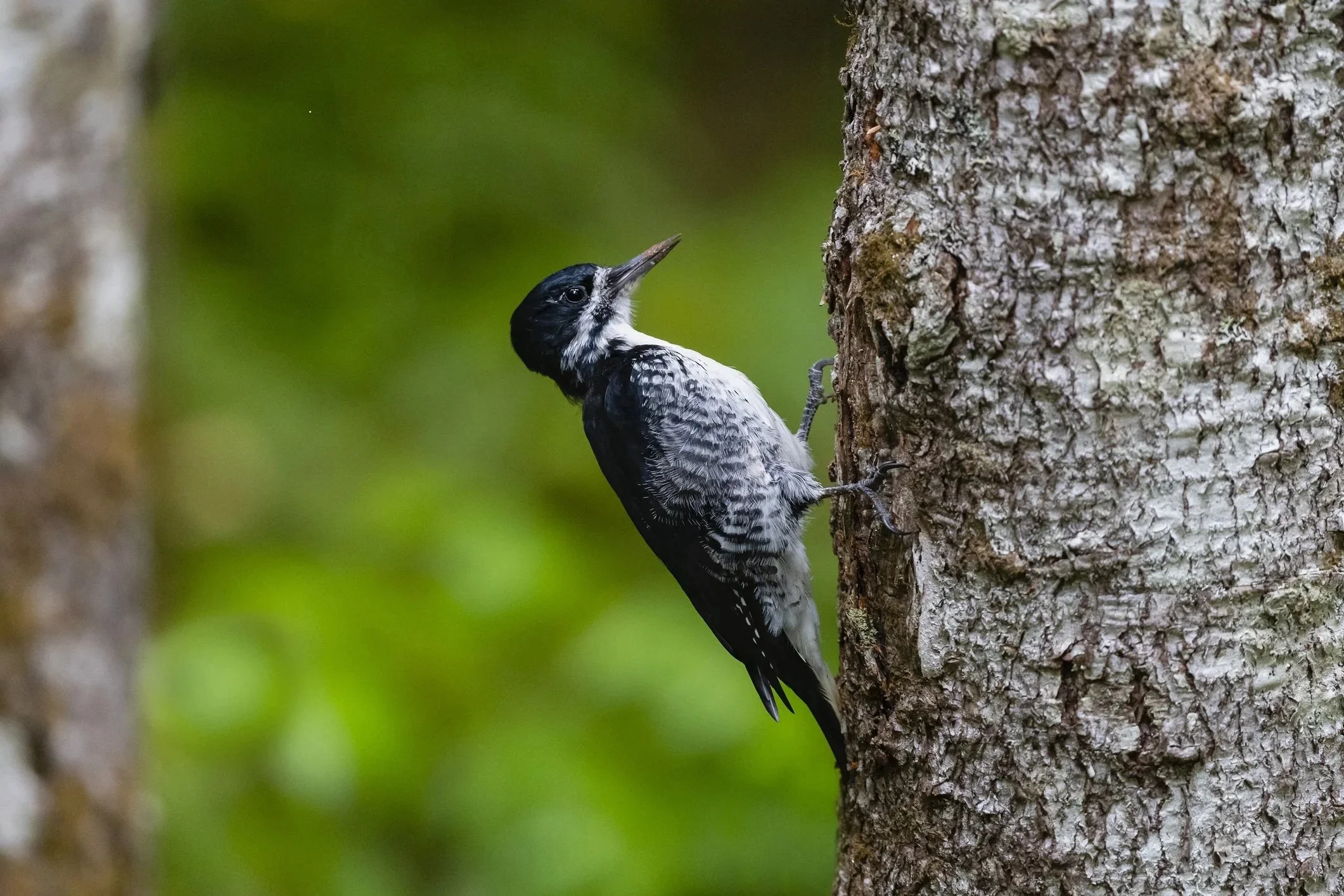
Bird of the Month: Black-backed Woodpecker
Written by Andy McCormick
A resident of high elevation habitats in the Cascades and northeastern Washington, the Black-backed Woodpecker is a sought-after bird in recently burned areas.
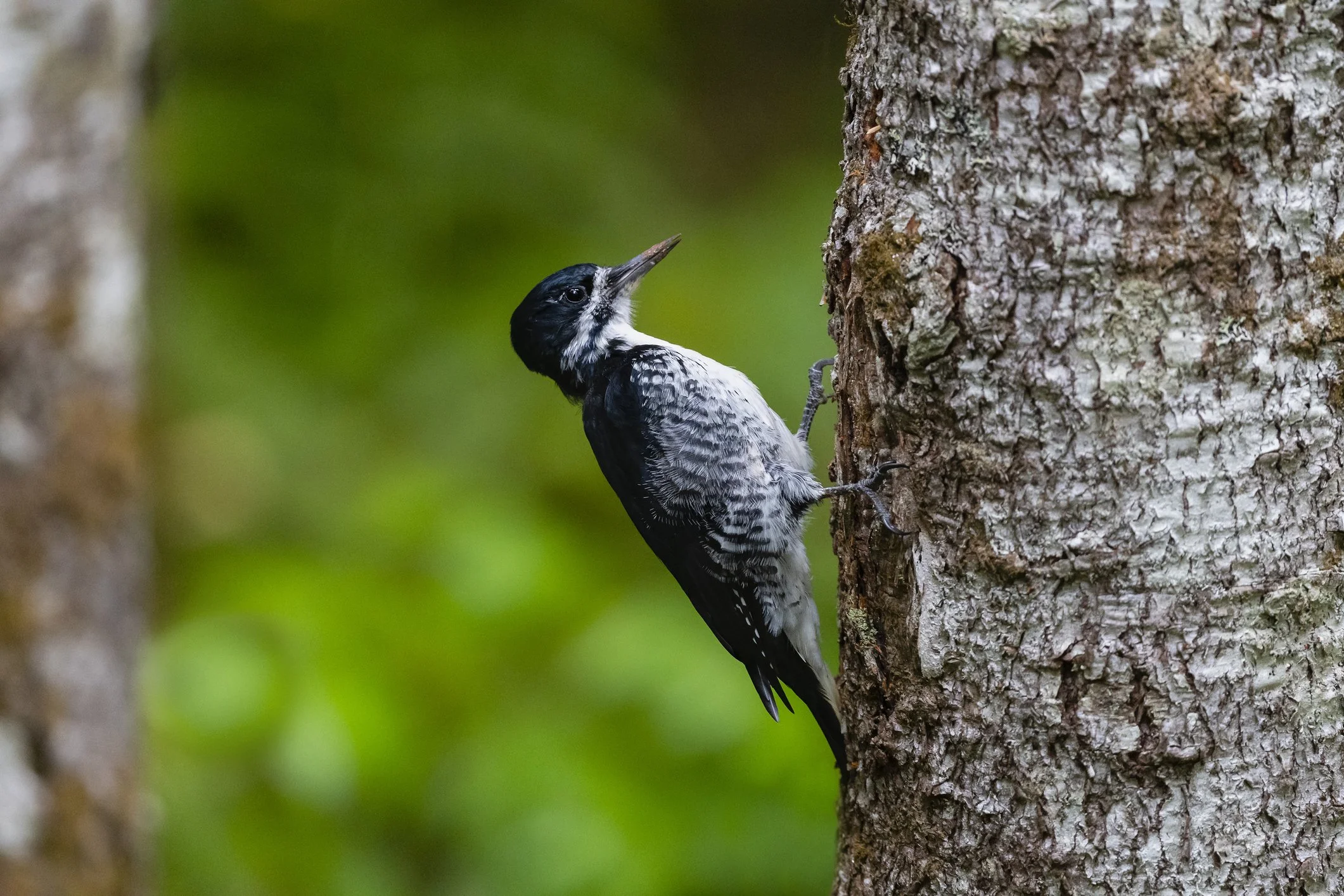
Black-backed Woodpecker
Scientific name: Picoides arcticus
Length: 9.5”
Wingspan: 16”
Weight: 2.5 oz (70 g)
AOU Alpha Code: BBWO
The Black-backed Woodpecker is most similar to the American Three-toed Woodpecker. The males of both species have a yellow patch on the crown which differs from all other male North American woodpeckers which have red on the head. The Black-backed is aptly named for its solid black back which has been described as like a tuxedo (Tremblay et al). It is heavily barred below, and the all-dark upper parts are marked only by the yellow crown and a “long white moustachial stripe, broadening at the rear” (Alderfer). The female is similar, except that its crown is all black.
This woodpecker’s three toes are arranged with two toward the front and the third toward the rear. The latter is held slightly to the side. It is not certain why some woodpeckers have only three toes, but it may be an adaptation to their foraging style of removing burnt portions of the bark on tree trunks to expose insects and their larvae. Photos, videos, and audio of Black-backed Woodpeckers can be found at the Macaulay Library.
Specialized to Hunt Tree Insects
Black-backed Woodpeckers have a specialized diet and are somewhat nomadic in their search for insects that invade old and dying trees. They will move to forest areas damaged by fire, flood, or disease as soon as three months after the trees have burned and frequent them for up to four years (Dunne). They forage in a methodical manner, chipping away pieces of the burned bark with a slight sideways flicking motion as they search for the larvae of wood-boring insects. Over time they may completely strip the bark off a burned snag. They will also forage on fallen trees in a similar manner.
These woodpeckers favor montane conifer forests of spruce, fir, and pine trees in the northern half of North America. Other than their search for beetle infestations, Black-backed Woodpeckers are generally sedentary and are resident in their range. They excavate a nest hole in which 3-4 white eggs are deposited. Incubation is by both parents switching off with the male spending most of the night on the nest (Kaufman). Young hatch in about two weeks and fledge in another three and a half weeks.
Conservation and Management
Despite a global standing as secure and common, Black-backed Woodpeckers are listed as vulnerable in Alaska, Washington, and Oregon and other western states. Long-term fire suppression and postfire salvage logging have been detrimental to this species. The resulting reduction of the number of dead or burned trees limits the amount of suitable habitat for these woodpeckers. Many studies demonstrate that breeding density among Black-backed Woodpeckers is higher in burned rather than unburned forests. Consequently, this species has been targeted for conservation priority in 13 states (Shunk). However, there is little information about existing management plans in place.
Proposals to address the preservation of damaged trees to support this and other woodpeckers have been offered and include leaving burned trees in clumps after fires where salvage logging is undertaken, and when possible, postponing salvage logging until five years after a fire. A proposal in Oregon suggests exempting “Woodpecker Management Areas” in mature lodgepole pine and lodgepole pine-dominated habitats from commercial and salvage timber management (Tremblay et al).
A Note on Taxonomy
The systematics of part of the family of woodpeckers was revised by the American Ornithological Society in 2018 after a review of the phylogeny (evolutionary history) and taxonomy (the science of classifying organisms) of woodpeckers based on DNA molecular studies. As a result, the Black-backed Woodpecker remains in the genus Picoides with the American Three-toed Woodpecker (P. dorsalis) and the Eurasian Three-toed Woodpecker (P. tridactylus). Picoides is derived from the Latin picus which refers to a general great black woodpecker. Its species name arcticus is from the Greek arktikos, referring to its northern range.

Andy McCormick, 2024 Audubon Washington Helen Engle Volunteer of the Year
Nine other woodpeckers formerly in the genus Picoides have been assigned to the resurrected genus Dryobates (Fuchs and Pons, 2015). These are Downy, Nuttall’s, Ladder-backed, Red-cockaded, Hairy, White-headed, Smoky-brown, Arizona, and Strickland’s Woodpeckers. https://blog.aba.org/2018/06/aos2018.html
References are available upon request from amccormick@eastsideaudubon.org.
Visit the Eastside Audubon Bird Gallery to read Bird of the Month articles covering over 200 bird species.