
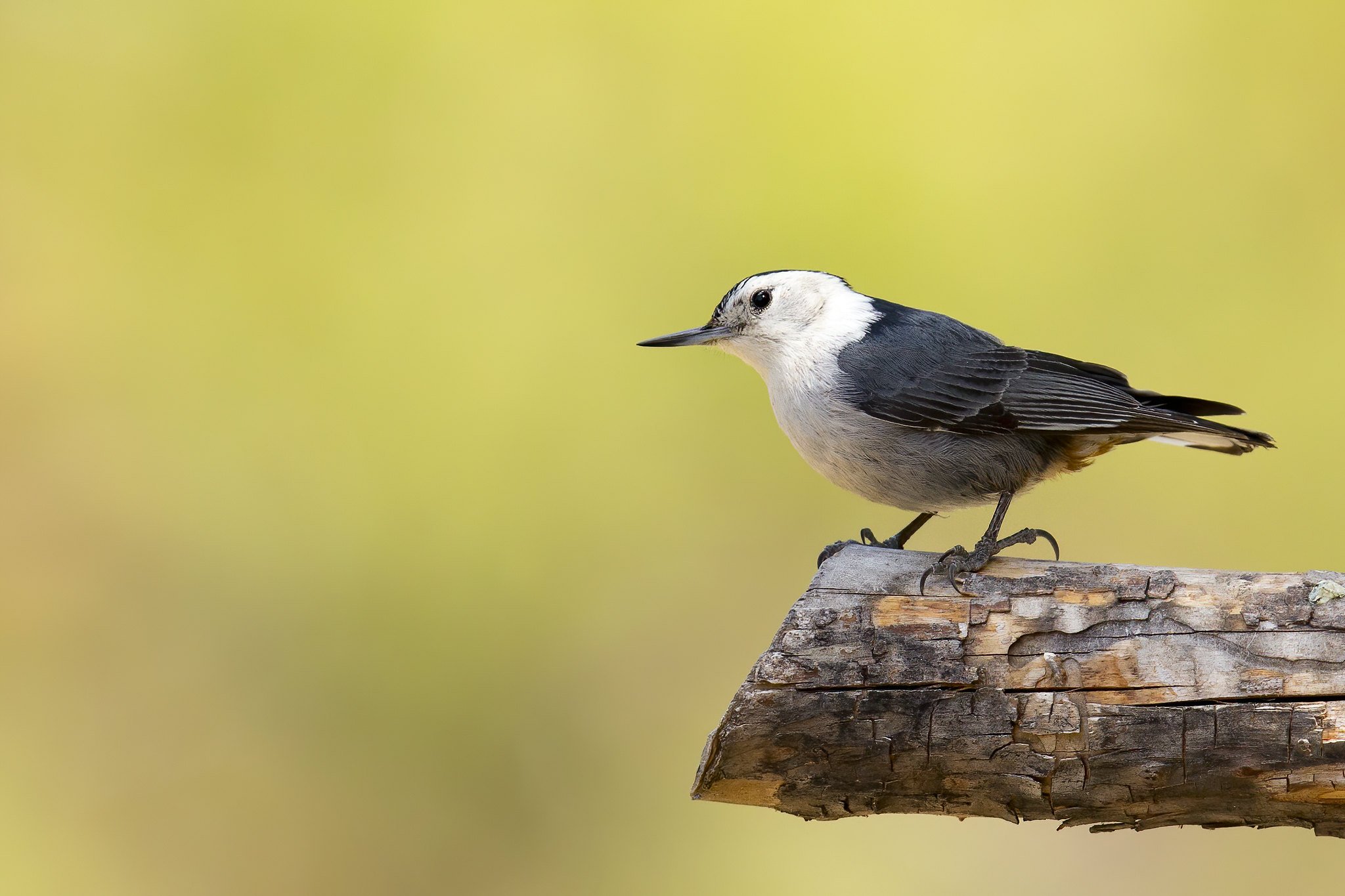
by Andy McCormick
White-breasted Nuthatch Sitta carolinensis
Length: 5.75” Wingspan: 11” Weight: 0.74 oz (21 g) AOU Alpha Code: WBNU
Two subspecies of White-breasted Nuthatch are found in Washington. One along the Columbia River and coast of SW Washington and the other in the Cascades and eastern counties.
The White-breasted Nuthatch is our largest nuthatch. Like other North American nuthatches, it has a gray back, but it has other distinguishing characteristics. Its face, chest and belly are white. Its stout chisel-like bill is more prominent than the bill of other nuthatches especially when it stretches its neck out during a rest from foraging. Its narrow black cap extends from the base of the bill across the head and then widens as it meets the gray back. The wing feathers also differ. They are marked with dark centers and white edges which are visible on the folded wing. The amount of rusty feathers in the undertail coverts and flanks varies from bird to bird.
White-breasted Nuthatches move quicky and with a jerky motion while foraging along tree limbs. They prefer heavier limbs where they probe crevices in the bark and they will chip away pieces of bark in search of insects and their larvae. They also probe for seeds and will include nut mast in their diet. The direction of their movements around tree limbs seems unpredictable and may include completely encircling a tree limb several times in succession. They move upwards along branches, but just as easily move head-first down a tree trunk or limb. While facing down they are able to pose by lifting their head horizontally as if to scan their surroundings.
Cavity Nester
Research on the White-breasted Nuthatches can be difficult for two reasons. These birds nest early in the year in existing tree cavities or old woodpecker holes. Other than possibly enlarging an existing cavity they do not excavate their own nest site. So, there may be little activity around the nest site making them difficult to locate. Secondly, White-breasted Nuthatches become quiet once the nesting period begins. Observers need to be vigilant to observe them during this time. Despite these difficulties, some nesting records do exist. Nuthatches in the Pacific Northwest often begin courtship behavior in March followed by nesting in April and May. They have also been known to nest in bluebird nest boxes, and this inclination has been used by researchers to study them at known locations providing opportunities for careful monitoring.
As a form of nest defense one of the pair of White-breasted Nuthatches will perform bill-sweeping inside and outside the nest with the body of an insect. This is thought to produce a foul-smelling chemical secretion which may assist in keeping predators from the nest (Grubb and Pravosudov). Red-breasted Nuthatches have a similar routine in which they place sticky tree resin at the entrance to their nests as a way to discourage predators.
White-breasted Nuthatches produce one brood per year. Typically, the female deposits 5-9 eggs in the nest hole. During incubation by the female the male brings food to the nest. After two weeks, the eggs hatch and first flight follows in another two weeks (Kaufman).
Status and Distribution
The White-breasted Nuthatch has a widespread distribution across woodlands in the United States, southern Canada, and the mountains of north-central Mexico. They favor mature deciduous woodlands such as forests of birch and maple. But a study in British Columbia showed that they can adapt to Ponderosa pine and Douglas fir forests.
Pairs of White-breasted Nuthatches typically stay together throughout the year and remain as resident birds in their range. Some pairs may mate for life. Although not migratory, in years when food is scarce, some White-breasted Nuthatches may move several kilometers or more from their territory. The White-breasteds do not experience the type of winter irruptions that occur among Red-breasted Nuthatches.
A Note on Taxonomy
Four North American nuthatches (White-breasted, Red-breasted, Pygmy, and Brown-headed) are included in the genus Sitta, from the Greek sitte, the name given to birds that “peck on a tree” by Aristotle (Holloway). There are 23 nuthatches worldwide included in this genus. The species epithet carolinensis refers to the area in the southeastern United States where European explorers first located this bird. The “Pacific” subspecies of White-breasted Nuthatch (S. c. aculeata) found in southwestern Washington is pale gray on the back and flanks and its call is a high pitched eeerh, eeerh (Alderfer). The “Great Basin” subspecies ( S. c. tenuissima) of central and eastern Washington is darker gray overall.
Photo credit: Mick Thompson
References are available upon request from amccormick@eastsideaudubon.org.
Visit the Eastside Audubon Bird Gallery to read Bird of the Month articles covering over 200 bird species.