
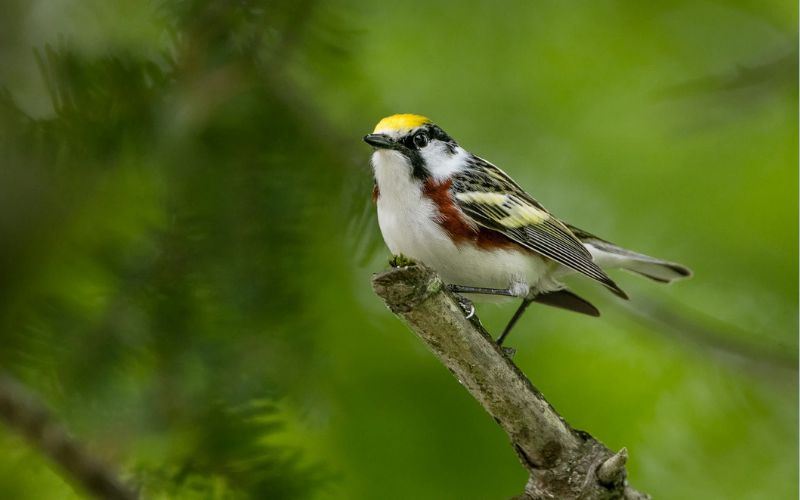
Bird of the Month: Chestnut-sided Warbler
Written by Andy McCormick

Andy McCormick, 2024 Audubon Washington Helen Engle Volunteer of the Year
Observations of Chestnut-sided Warblers in Washington have increased in recent years, and the first record of their nesting was recorded in the state was in 2023. Will they nest again in our state?
During spring and summer, the male Chestnut-sided Warbler has a bright yellow crown, a narrow black facial mask outlining the crown, eye, and throat, and a wide bright chestnut streak along its side. The female is similarly marked with a greenish-yellow crown, less black in the face, and a smaller chestnut streak on the side. Both the male and female lose their breeding plumage in fall as they molt feathers to a green back and light gray chest and belly. They have a white eye ring and two wings bars in both plumages. Photos, videos, and vocalizations of Chestnut-sided Warblers can be found at the Macaulay Library.
The first Chestnut-sided Warbler collected in Washington was in 1960 and gradually it has become a more frequent, although still rare, summer visitor to the state (Wahl, et al). The observation of nesting behavior in 2023 was unexpected and included a pair of birds engaged in singing territorial defense by the male and nest building by the female (Maron and Borre). It is unknown if the pair were able to successfully fledge any young. One other Pacific Northwest successful nesting was earlier reported from Puntchesakut Lake in British Columbia (Aversa et al).
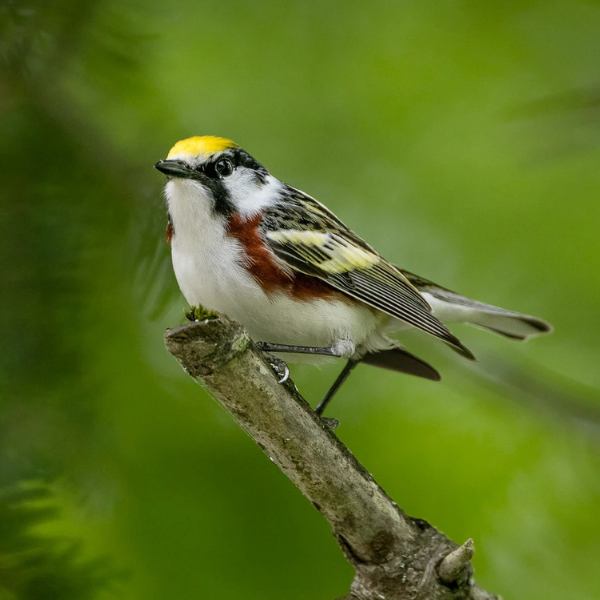
Chestnut-sided Warbler
Scientific Name: Setophaga pensylvanica
Length: 5”
Wingspan: 7.75”
Weight: 0.34 oz (9.6 g)
AOU Alpha Code: CSWA
STATUS AND DISTRIBUTION
Across a latitudinal band covering southern Canada from central Manitoba to Nova Scotia and south through the Great Lakes region and the northeastern United States to parts of Kentucky and Georgia, the Chestnut-sided Warbler is a common wide-ranging breeding songbird. It is a mid-range neotropical migrant which winters in a variety of woody and shrubby habitats in Central America from the Yucatan Peninsula to Panama. It typically migrates north in late April and May by crossing the Gulf of Mexico then proceeding to temperate woodlands.
The Chestnut-sided Warbler is considered one of the “eastern” warblers but since 1900 it has been expanding its range westward. It is now more common than it was historically including during the time of John James Audubon who reported to have seen a Chestnut-sided Warbler only once (Byers et al). Expansion of their favored type of shrubby habitat in Washington due to fire or logging may provide suitable habitat for this species of warbler to continue its century-long range expansion into the west.
SHRUB HABITAT SPECIALIST
The Chestnut-sided Warbler is one warbler that has done well with the changes brought about by human expansion. It nests in shrubby understory and in areas of early successional growth such as abandoned farmlands and forest clearcuts (Byers et al). The reduction of forest habitat has had a negative effect on many warbler species but the Chestnut-sided has made good use of the increase in edge habitats characterized by brambles and other tangled plants.
Combining strips of bark, grasses, plant down, and animal hair the female Chestnut-sided Warbler builds an open cup nest low in a shrub or web of branches. Usually, four eggs are deposited and incubated by the female for about 12 days. Both parents feed the young which leave the nest in another 12 days (Kaufman). Their diet is almost exclusively insects, but they will eat some berries in winter.
A NOTE ON TAXONOMY
In 2011 the American Ornithological Society revised the classification of warblers. This resulted in changes to the scientific names of many warblers including the Chestnut-sided. Older records of Chestnut-sided Warbler used the scientific name Dendroica pensylvanica. However, the reclassification resulted in the species being moved to the genus Setophaga, which is named from the Greek for setos, a moth, and phagein, to eat or devour, referring to the insect-eating behavior of this and other warblers. The International Code of Zoological Nomenclature Principle of Priority holds that the oldest name applied to a taxon is the valid name even if it is misspelled, as the Latin for Pennsylvania is for the Chestnut-sided Warbler resulting in the name Setophaga pensylvanica.
Photo credit: Shirley Donald/Audubon Photography Awards
References available upon request from amccormick@eastsideaudubon.org.