
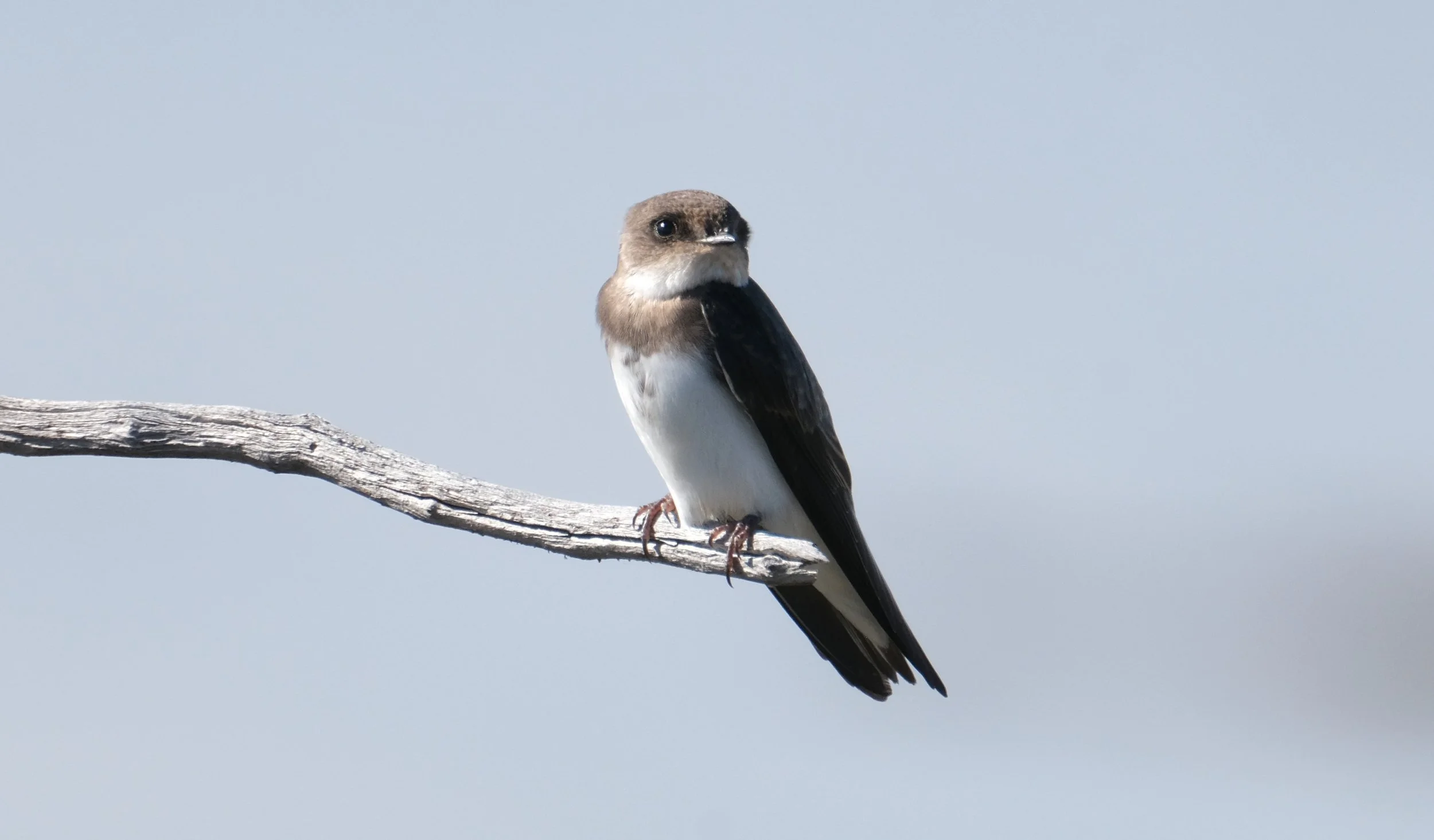
Bird of the Month: Bank Swallow
Written by Andy McCormick
With a worldwide distribution the Bank Swallow is the world’s most cosmopolitan swallow. In Washington, it nests in the sandy banks of rivers and streams.
Bank Swallow
Scientific name: Riparia riparia
Length: 5.25”
Wingspan: 13”
Weight: 0.47 oz (13.5 g)
AOU Alpha Code: BANS
The Bank Swallow is our smallest swallow. It has a grayish-brown back and tail with a significantly paler rump (Aversa et al). It is white below with the exception of a prominent brown band on the upper chest which can appear to separate a mostly white head from the white belly (Dunne). Bank Swallows are usually seen in flocks flying low over water while feeding on flying ants, bees, wasps, flies, beetles, dragonflies, and other insects captured on the wing. Like other swallows it is an aerial insectivore that feeds almost exclusively by catching insects in mid-air.
Bank Swallow is one of six swallow (or martin) species in the genus Riparia, which is from the Latin for being associated with stream banks (Holloway). The genus name is repeated as the species name. Riparia is also the root for the name of riparian habitat, an ecosystem distinguished by moist and mild micro-climates along waterways. Swallows in this genus are characterized by their underground nesting behavior. In the western hemisphere, swallows take their name from the Anglo-Saxon swalewe, however, in Eurasia and Africa, many are called martins from the French martin, meaning little Mars. The Bank Swallow in those regions is called the Sand Martin.
Status and Distribution
Bank Swallows breed in a wide swarth over the northern hemisphere from Alaska across Canada and the northern United States to the Maritime Provinces. In Europe, they breed from western Europe, Scandinavia south to the Mediterranean region, across Russia and northern China to Japan as long as they can locate soil banks that they can excavate. In fall, Bank Swallows withdraw from their breeding range to wintering habitat of fields, marshes, and seashore in South America, Africa, and part of Indonesia. Most research on Bank Swallows has been conducted in breeding areas and little is known of their habits on wintering grounds (Garrison and Turner).
Sandbank Nester
Bank Swallows nest in colonies ranging from 20 to 2000 breeding pairs. We do not know exactly how a colony of Bank Swallows selects a breeding site, but previous success at a location seems to be one factor. They prefer steep banks into which they can burrow perpendicularly and stay parallel to the land above. The quality of the sand and gravel matters as it must be workable by the males which begin the tunneling by slashing at the sandy soil with their conical shaped bill. Once they loosen the sand, they kick it out of the burrow with their feet and sweep it out with their wings (Garrison and Turner). When completed the burrow will range in depth from 30 to 100 cm (about one to three feet) long. The male makes display flights around the entrance to the burrow to attract a female.
Once mated, the pair work in the burrow to construct a nest mat of grasses, rootlets, and other nearby materials. Even if an old burrow is used, the swallows will usually build a new nest. A typical clutch will consist of four to five white eggs which are incubated mostly by the female with the male providing relief when the female leaves the nest (Garrison and Turner). Incubation takes about two weeks. The young are fed insects by both parents and will leave the nest in another three weeks (Kaufman).
Population and Conservation
Bank Swallows are considered not-threatened worldwide and they have maintained healthy populations in most areas. It is difficult to determine the size of the population in North America, but an estimate of the population in Europe and Russia in the 1990s in the range of 2,800,000 and 14,000,000 breeding pairs provides some idea of the distribution of this swallow (Garrison and Turner).
Some breeding sites can be reused, but they are ephemeral and subject to change from natural and human effects. Weather and streamflow, especially during winter and spring, can alter the structure of the embankment making it unusable by the birds. Some colonies have been negatively affected by erosion control projects which groom vertical slopes to a 45-degree angle, or place large rocks along the stream banks. Some authorities have taken measures to mitigate the effect of these projects. California, for example, created artificial banks and enhanced natural banks with additional burrows on the banks of the Sacramento River.

Andy McCormick, 2024 Audubon Washington Helen Engle Volunteer of the Year
Photo Credit: Alyssa Epilepsia
References are available upon request from amccormick@eastsideaudubon.org.
Visit the Eastside Audubon Bird Gallery to read Bird of the Month articles covering over 200 bird species.