
Two female Anna's hummingbirds struck the glass outside a Starbucks at the University of Washington while students waited in line for coffee. The birds lay on the pavement for 90 minutes. Several students stepped out with cups and bagels and stopped to help. Nothing could be done.
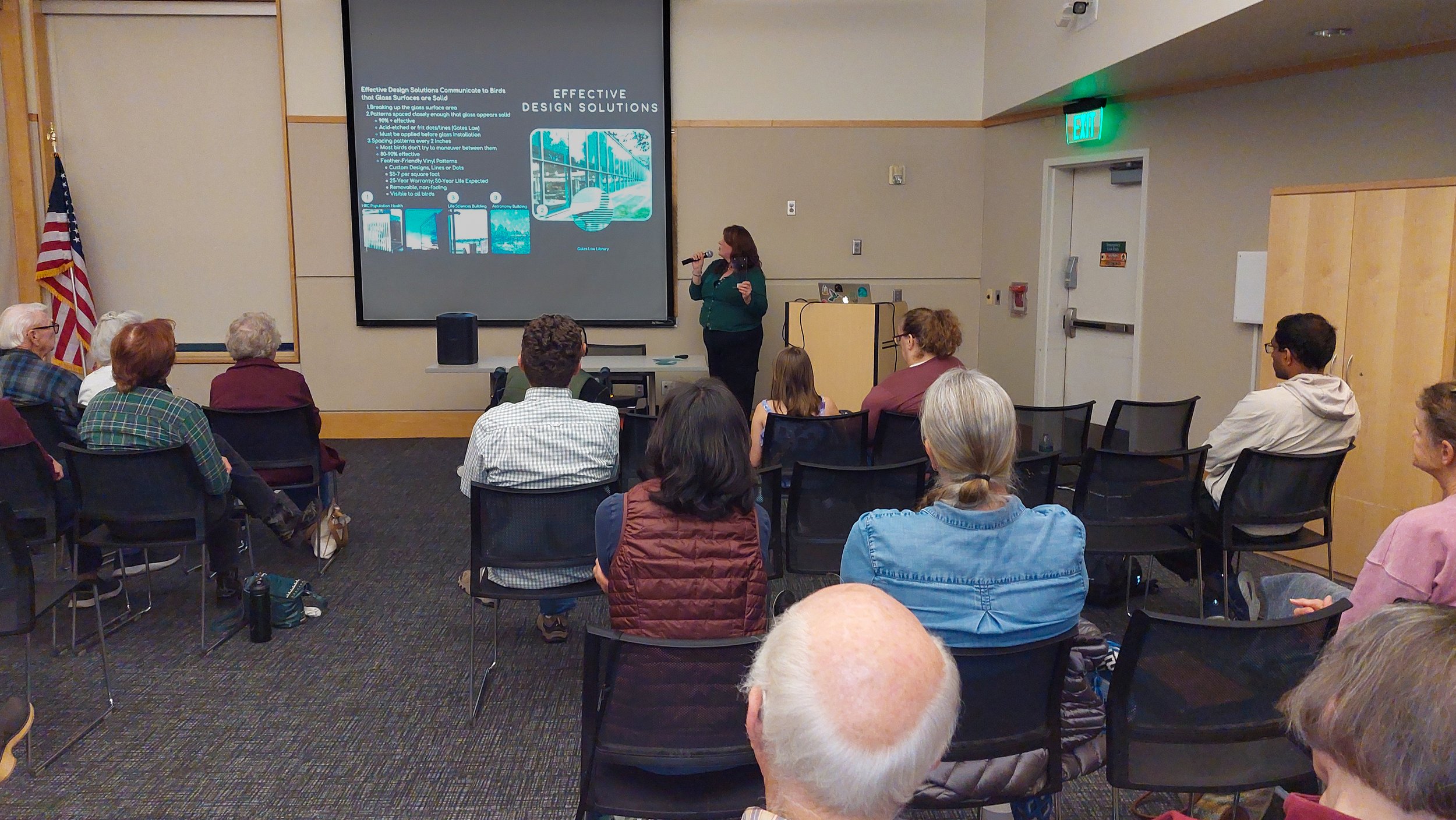
Judy Bowes presents her Bird Friendly Campus research at the Redmond Library on Sept. 23. Photo: Eastside Audubon
The scene is one Judy Bowes described Wednesday, Sept. 23, at the Redmond Library, during a talk hosted by Eastside Audubon. A doctoral candidate in architecture at the university, she has spent five years researching bird-building collisions. Early in her presentation, she asked who in the room had seen, heard or otherwise witnessed a bird hit a window.
"Everybody in this room," she said.
Bird-building collisions may kill more than a billion birds a year in the United States, research published in 2024 suggests. An earlier study published in 2014 estimated that roughly 56 percent of deaths occurred at low-rise buildings, 44 percent at residences and less than 1 percent at high-rises.
Counting each morning
Four years ago, Ms. Bowes started Bird Friendly Campus. Her teams have watched 28 buildings through 14 academic quarters. They walk their routes each morning, racing the crows. The crows have learned where birds fall, and they wait.
She estimates that monitoring finds only about 7 percent of collision victims. Even so, her teams have recorded more than 40 species. She puts the campus toll at 20,000 birds a year, and calls that a low estimate.
Among the most vulnerable is the varied thrush, a forest bird that winters around Seattle and has declined for decades. Because of it, winter is often the deadliest season on campus, she said.
A fight over dots
The fix is simple. Birds need to see that glass is solid. Visible patterns applied across the outside of a window, spaced no more than two inches apart, can reduce collisions. Feather Friendly vinyl patterns cost $5 to $7 a square foot, Ms. Bowes said.
Getting the university to agree to add dots to existing buildings took two years. Officials worried what donors and parents would think of buildings covered in dots, she said. Ms. Bowes showed them the worst photos she could find. Some people cried.
The standards passed about a year ago, she said. Every new campus building must now meet bird-friendly design standards. Six existing buildings were scheduled for treatment by year's end.
"Nobody's ever complained about the dots to me after they've been up," she said. "It's always people worrying beforehand."
From the audience to City Hall
Sayna Parsi, a new Redmond City Council member, took the microphone before Ms. Bowes did. She had a message for the room about what to do with the research it was about to hear.
She spoke to those who felt overwhelmed by the world's problems and unsure how to make a difference.
"I want to tell you as someone who's recently joined the council, there is a lot that you can do," she said.
"You're going to go to your city council members and you're going to tell them that you really, really care about light pollution," she said. "And you're going to send them data."
Ms. Parsi has worked with Eastside Audubon for years. She is a member and helped write the group's Lights Out page, which asks residents and cities to dim their lights during migration so fewer birds end up on the pavement.
Protect your own windows
Ms. Bowes recommends Feather Friendly vinyl dots, applied to the outside of the glass:
For large or multiple windows (easier to apply)
Report collisions with her app, Avian Impact, at avianimpact.com, and sign up for the Bird Friendly Campus newsletter at birdfriendlycampus.com.