
By Andy McCormick
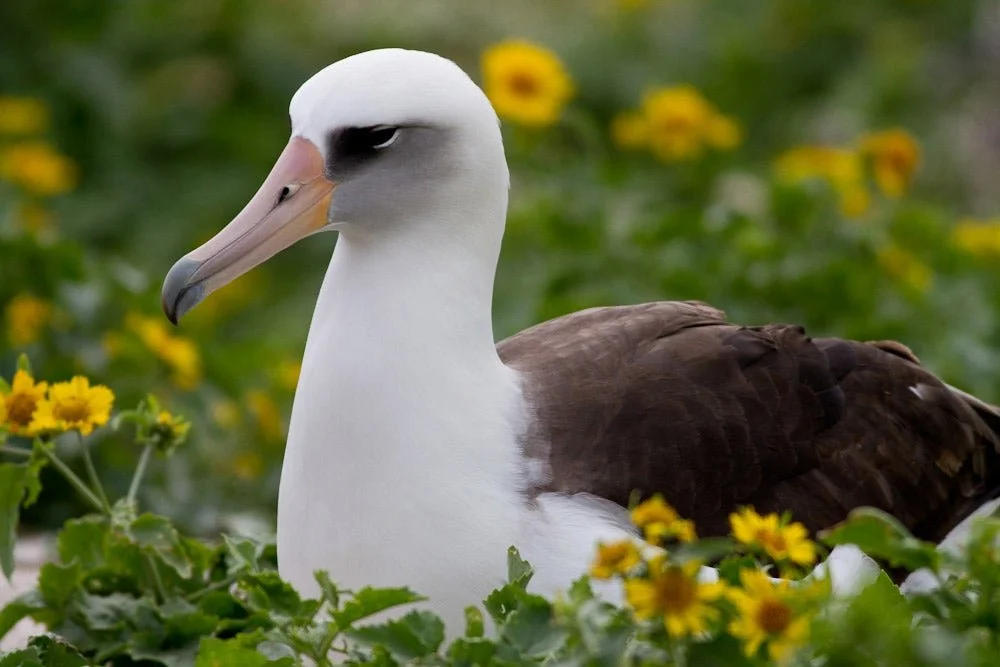
Laysan Albatross Phoebastria immutabilis
Length: 30” Wingspan: 79” Weight: 6.8 lbs. (3,100 g) AOU Alpha Code: LAAL
A winter visitor to Washington waters, the Laysan Albatross can be seen during pelagic birding trips and also rarely from land.
The Laysan Albatross is about the size of the Black-footed Albatross (See entry in the EAS Bird Gallery,) which is about medium size for an albatross. It looks like a very large Western Gull although it dwarfs it in size. It has a white body and dark wings, and a large pink bill (Dunne). The underwing has variable amounts of black and white. The wings are long and tapered reaching a wingspan of nearly 8 feet making this bird ideally adapted for a life of riding the wind over the waves. Albatrosses, shearwaters, and petrels use “dynamic soaring” to ride the updrafts from waves arcing into the air as they gather speed, then glide down to catch the next updraft in a continuous effortless flight moving these birds over thousands of miles of open ocean.
Slow to Maturity
The breeding cycle for most Laysan Albatrosses begins in the Hawaiian Islands in November. Males usually arrive first, but females begin construction of the nest by scraping a depression in the sand forming a raised ring-shaped moat around the nest. This is thought to protect the nest from flooding (Awkerman et al). The female lays only one egg and jointly with the male incubates it for over 60 days. Once hatched, chicks grow slowly. They require regular feeding by the adults for almost four months before they can fledge. Adults fly at night to feed on shrimp and return to the nest to regurgitate food for the nestling.
This level of care requires a large expenditure of energy by the parents. The effort is so taxing that a pair cannot raise more than one chick, and a single parent cannot raise even one. Extra-pair assistance by non-breeding birds is frequently observed. Pairs of females are also known to share the raising of a chick. The total length of the breeding period from the arrival of the adults to when they leave in July is 290 days (Awkerman et al).
Hawaiian Island Breeder
Laysan Albatross is named for Laysan Island, a small atoll in the northwestern Hawaiian Islands about 930 miles northwest of Honolulu. Laysan and other islands in the Hawaiian archipelago were created by coral growth and geological uplift, and for millions of years have formed the primary breeding range for Laysan Albatrosses which return every November. The specific islands have changed over time as the birds responded to changes in their environment. In a remarkable expansion of thousands of miles, a colony of Laysan Albatrosses was discovered off Guadalupe Island near Baja California, Mexico in the 1980s.
By July, the young birds fledge from their nest and join the adults in a flight from Hawaii northwesterly toward Japan. From there they move to feed in the cold waters off the Aleutian Islands, Alaska. Some Laysan Albatrosses from Mexico are thought to disperse northward along the west coast of North America and can be seen in deep water off Washington during the winter months as they forage beyond the edge of the continental shelf.
Distribution
Laysan Albatross is named for Laysan Island, a small atoll in the northwestern Hawaiian Islands about 930 miles northwest of Honolulu. Laysan and other islands in the Hawaiian archipelago were created by coral growth and geological uplift, and for millions of years have formed the primary breeding range for Laysan Albatrosses which return every November. The specific islands have changed over time as the birds responded to changes in their environment. In a remarkable expansion of thousands of miles, a colony of Laysan Albatrosses was discovered off Guadalupe Island near Baja California, Mexico in the 1980s.
By July, the young birds fledge from their nest and join the adults in a flight from Hawaii northwesterly toward Japan. From there they move to feed in the cold waters off the Aleutian Islands, Alaska. Some Laysan Albatrosses from Mexico are thought to disperse northward along the west coast of North America and can be seen in deep water off Washington during the winter months as they forage beyond the edge of the continental shelf.
Conservation
The expansion of nesting Laysan Albatrosses to the coast of Mexico may be a by-product of their recovery from a long period of being hunted for their feathers, a process which destroyed entire colonies some of which have never recovered (Awkerman et al). Breeding colonies numbered only 18,000 pairs in 1922, but by 2005 the population had increased to 590,000 breeding pairs. The world population is now estimated up to 2.5 million birds (Kaufman).
Despite this success, Laysan Albatross is negatively affected by other changes in its ancestral range in the central Pacific Ocean. For example: Previous military activity cleared some colonies to prevent collisions with airplanes, extensive human development on the Hawaiian Islands has impacted colonies, albatrosses can become bycatch on longline fishing equipment and drown, and some albatross and seabird colonies have been decimated by infestation of predators: rats, mongoose, and feral cats and dogs (Awkerman et al). More recently, examination of light weight albatrosses that have died without an apparent injury has revealed accumulation of plastic particles in their stomachs. The plastic cannot be digested, and its presence prevents the ingestion of food and water leading to the bird’s death.
In response to these threats, Laysan Albatross is listed as near-threatened (BirdLife Internation Red List). Several interventions are ongoing to protect them and their habitat. Interventions currently being implemented include monitoring of breeding colonies, extermination of rats and other predators from some islands, cancellation of driftnet fisheries, and flagging of longline fishing lines to frighten birds away from being hooked by the lines.
Photo credit: Ron Horn/Audubon Photography Awards
References are available upon request from amccormick@eastsideaudubon.org.
Visit the Eastside Audubon Bird Gallery to read Bird of the Month articles covering over 200 bird species.