

By Andy McCormick
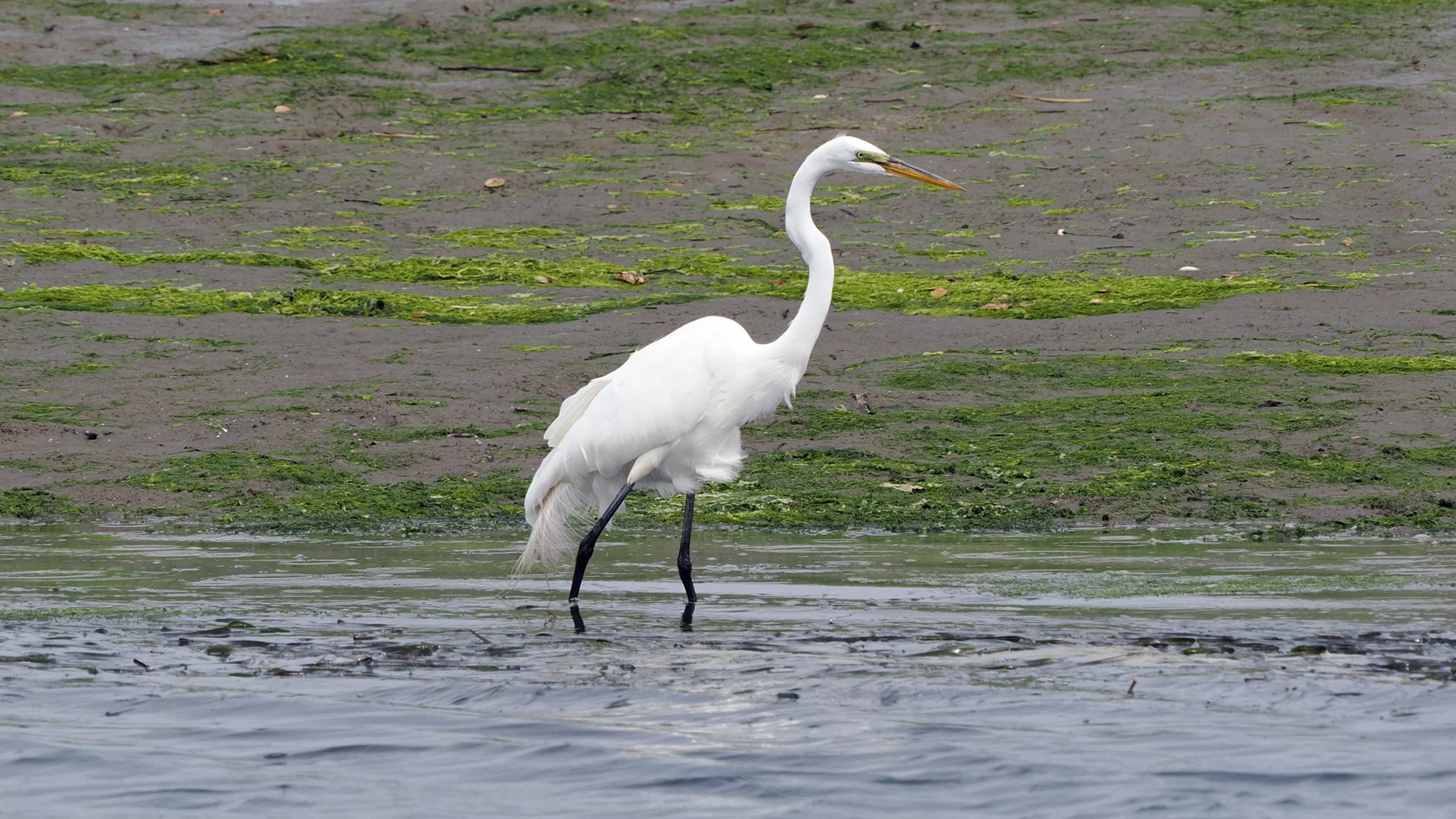
Great Egret Ardea alba
Length: 39” Wingspan: 51” Weight: 1.9 lbs. (870 g) AOU Alpha Code: GREG
A breeding bird of the Potholes region, the Great Egret is Washington’s largest white heron.
That Great Egrets still walk the Earth is a major conservation achievement. Herons of many species were hunted nearly to extinction for the millinery trade when their long plumes and other feathers were used to decorate hats and clothing in the 19th and early 20th Century. The founders of the National Audubon Society rallied to safeguard these exquisite birds and succeeded in saving them by winning protection of their roosts and breeding colonies. Today the image of the Great Egret is part of the logo of the National Audubon Society and serves as a reminder and symbol of the organization’s long term successful conservation work. Today the population of the Great Egret continues to grow nearly to its historic level.
A Stately Presence
Nearly as tall as the Great Blue Heron, the Great Egret is distinctive with all-white plumage which features wispy plumes (aigrettes) extending along its back to beyond the tail. Its bill is long and yellow and during the breeding period the skin by the bill turns lime green (Alderfer). The legs and feet are black. It shares many behaviors with Great Blue Heron including stalking while hunting, flying with its neck retracted and feet extended, and nesting in trees. It forages in a variety of habitats connected to fresh, brackish, and saline water that feed marshy areas, coastal lagoons, tidal flats, estuaries, riverbanks and lakeshores (Alderfer). Great Egrets may be seen feeding solo or in small flocks.
Great Egret shares the genus of the large herons named appropriately Ardea from the Latin for heron. Fifteen other large herons from around the world are also placed in this genus. The species name alba is from albus, Latin for white (Holloway).
Widespread Nesting and Diet
Great Egrets are cosmopolitan and are comfortable in a wide variety of habitats. Not all of these egrets nest in trees and some will build nests in thickets or marsh grass. Usually, three to four blue-green eggs are deposited in the nest and young will hatch after both adults share incubation for about three weeks. Chicks are dependent on the parents and both male and female will feed the chicks with food they regurgitate for them. Fish is the primary staple of the Great Egret’s diet, but they will capture crustations, snakes, salamanders, and aquatic insects, and in fields they will consume mice, voles, and other small mammals. First flight if the young follows about six to seven weeks after hatching (Kaufman).
Distribution and Subspecies
Great Egrets breed on all continents except Antarctica. They are still recovering from near extinction and are expanding their range in Western Europe and in Sub-Saharan Africa. There has also been some northward expansion from the United States into Canada. The breeding range in Washington is located around the Potholes region of the Bureau of Reclamation Columbia Basin Project. These birds can also be seen in fall migration at Ridgefield National Wildlife Refuge just north of Vancouver, WA.
Four subspecies have been identified and are based on relative size, and color of the bare parts, which become enhanced with the flush of hormones produced by the birds during breeding. Great Egret (alba), Ardea alba alba, is large and breeds from Western Europe across Asia to the Russian Far East and Japan. When breeding its bill turns black, the lores (the skin between the eye and the base of the bill) become bright green, and the legs are dull yellow to reddish. Great Egret (modesto), A. alba modesta, is small but similar to alba. It occurs from the Indian Subcontinent east to Southeast Asia and south to Australia and New Zealand. During breeding it has an all-black bill, green lores, and a reddish wash on dark legs. Great Egret (African), A. a. melanorhycnchos. is small and similar in size to modesto. It is resident across Sub-Saharan Africa. During breeding the bill and legs are black; the eye is red; and the lores are blue-green. Great Egret (American), A. a. egretta, is also similar in size to modesto and occurs from North to South America. The bill is orangish-yellow, and the legs are black during breeding. (McCrimmon et al).
Photo credit: Andy McCormick
References are available upon request from amccormick@eastsideaudubon.org.
Visit the Eastside Audubon Bird Gallery to read Bird of the Month articles covering over 200 bird species.