
Written by Andy McCormick
The Terek Sandpiper is a bit larger than the Spotted Sandpiper and bobs its tail in a similar fashion, but the resemblance ends there. As it moves on its short orange legs, it looks squat and front-weighted. Its long, upturned bill accentuates both its length and forward-leaning posture. It flies on long wings. Adult Terek Sandpipers have a gray upper body and are white below. In breeding plumage, they develop dark spots on the scapulars giving the appearance of dark lines on the back. The juveniles have a light brown back.
The Terek Sandpiper is classified in its own genus Xenus, from the Greek xenus, meaning stranger. The species name cinereus is from the Latin cineris, ashes, referring to the bird’s overall ash-gray coloring.
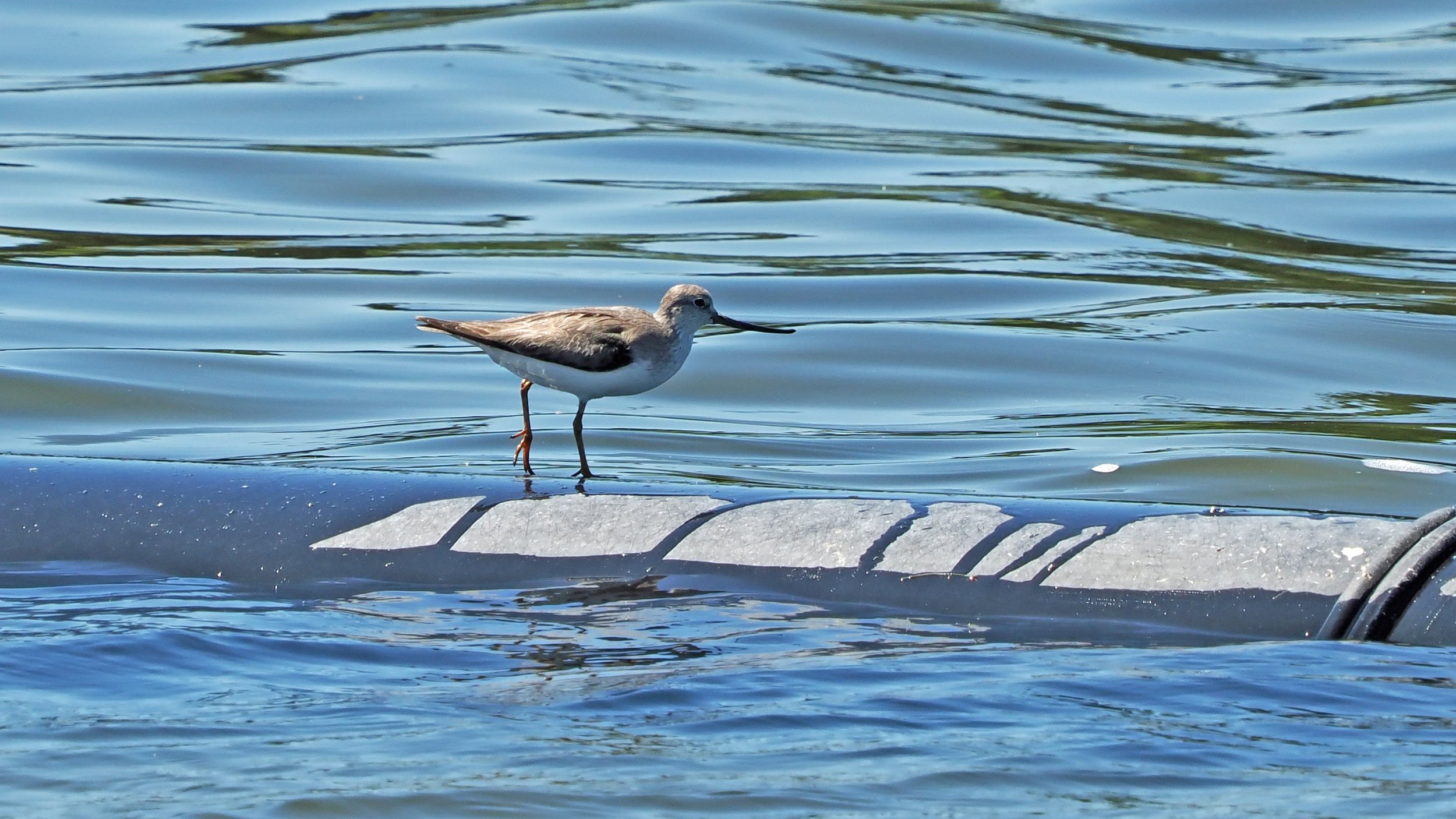
Terek Sandpiper
Scientific name: Xenus cinereus
Length: 9.1”
Wingspan: 24”
Weight: 2.9 oz (82 g)
AOU Alpha Code: TESA
Widespread in Eurasia
Terek Sandpiper is named for the Terek River in the Northern Caucuses where Georgia and Russia share a border. This is where the first specimen was collected for science (Mlodinow et al). However, this intrepid sandpiper is widespread with a range that expands across Eurasia and long-distance migration routes that cover 9,000 to 11,000 kilometers (5,500 to 6,800 miles) extending as far south as New Zealand and Australia.
Terek Sandpipers occupy a broad breeding range across Europe and northern Asia including Ukraine in the west with a more recent expansion northward to Finland. The range encompasses all of Russia and continues to the Korean Peninsula, Japan, and China. Following a long migration, Terek Sandpipers begin arriving on the tundra breeding grounds in late March with most arriving from mid- to late-April. They spend approximately three months there during the breeding period.
In fall, Terek Sandpipers tend to migrate due south from their breeding areas and in winter they populate coastlines from the Arabian Peninsula, east across India, southern China, and Indonesia to New Zealand and Australia (Mlodinow et al). Some Terek Sandpipers from the Kamchatka Peninsula in northeastern Russia begin their migration in early July. Since they pass close to Alaska, a few each year are observed in that part of North America. This year’s sighting in Stanwood is of a bird which undoubtedly continued flying southeast.

Andy McCormick, 2024 Audubon Washington Helen Engle Volunteer of the Year
Prone to Vagrancy
Due to its expansive range and long migration routes, the Terek Sandpiper is a good candidate for flying off course in fall and becoming a “vagrant” in new territory. This type of vagrancy is more common among juvenile birds which are making their first migration. Many birders chase these birds to see them and add them to their life list, country list, or even their county list. The Terek Sandpiper that landed in Stanwood, WA in July 2026 attracted hundreds of birders in the first few days after it was found. It kept a regular schedule of roosting at the Wastewater Treatment Plant during high tide and flying to the coast at low tide when the mudflats were exposed.
Despite its record of vagrancy, there are only a few records in North America. Prior to the current visit to Washington, there were only two records along the Pacific Coast: one on Vancouver Island, BC in July 1987 and another at Monterey, CA in August 1988. However, there are more frequent appearances in western Alaska along the Bering Sea, an area which is south of the bird’s breeding area on the Kamchatka Peninsula.
Nesting and Brooding
Terek Sandpipers can vary in some habits and behavior over its extensive range especially with regard to the location of nest sites, diet choices, and foraging strategies. They will almost always nest near water, but the nest might be located on the ground in the open, on floating material, in shrubbery, or on a tree trunk. They are active feeders and may be the most energetic of the shorebirds, moving quickly in short runs on a mudflat in search of prey. The curved bill serves both to nab insects in the air and to scythe through the water to sort out crabs, fish, and other prey. They might forage on their own, but during migration, they are likely to forage in flocks of various sizes (Mlodinow, et al).
Conservation and Management
The Terek Sandpiper is a species of Least Concern with an estimated worldwide population between 173,000 and 313,000 mature individuals (IUCN – International Union for Conservation of Nature at BirdLife International). Nevertheless, there are indications that its population is declining along the East Asian–Australasian Flyway especially along the coasts of the Yellow and East China Seas. Threats to the Terek Sandpiper are similar to those of other shorebirds. In East Asia these include industrial expansion along the coast, reclamation of wetlands for development, hunting for subsistence lifestyles, and shoreline loss due to climate change especially during high tides and storms. The Terek Sandpiper is being actively monitored by the Asian Waterbird Census.
Photo Credit: Andy McCormick
References are available upon request from amccormick@eastsideaudubon.org.
Visit the Eastside Audubon Bird Gallery to read Bird of the Month articles covering over 200 bird species.