


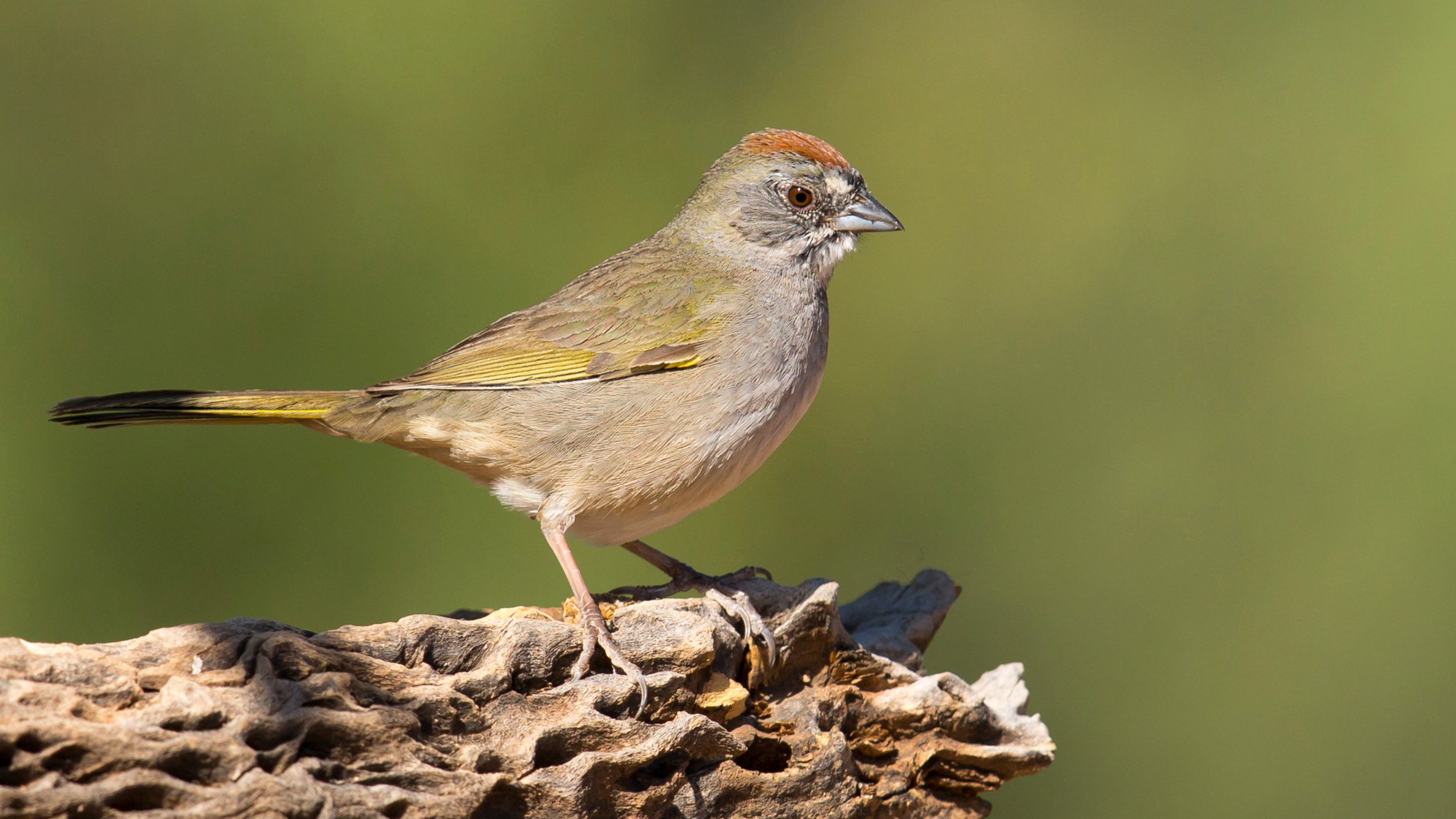
The Green-tailed Towhee, common in much of the Great Basin area, is a local breeder in the shrubby slopes of the Blue Mountains of southeastern Washington.

Every December, thousands of volunteers across North America head outdoors to count birds — helping scientists understand how our feathered neighbors are doing. The Audubon Christmas Bird Count (CBC) isn’t just a fun birding day — it’s the oldest and largest citizen science project in the world, and it depends entirely on volunteers like you.
Eastside Audubon is now accepting applications for two funding opportunities supporting local conservation and education efforts.
The Puget Sound Seabird Survey is looking for birders in King County to join this established Community Science program.
In the quiet of the woods the bubbling song of the Ruby-crowned Kinglet erupted, and the high trill of the Brown Creeper signaled its presence. The hormonal drive to breed had birds singing regardless of the weather.
If you have been following the news you will have undoubtably heard about the controversy surrounding the Audubon name. Our Audubon Chapter has been following these developments closely the last few years.
John James Audubon (1785-1851) was not a member of the National Audubon Society, which was founded in 1905. The organization was named in his honor. He is considered to be an important figure in Ornithology, as he documented and painted most of the bird species found in North America. His Birds of America collection was one of the earliest efforts to paint birds for field identification.
This famous Ornithologist also had a very dark side. He was a white supremacist who enslaved and bought and sold black people. To prove that white people were superior to any other race, he robbed the graves of Native Americans and Mexicans for skulls to gather “evidence” for his eugenicist beliefs. He killed and ate the birds he illustrated. He committed both academic fraud and plagiarism. He was an ardent supporter of slavery and wrote critically about emancipation.
For the last 2 years, the National Audubon Society grappled with the decision of a possible name change due to this man’s complicated history. Earlier this year, after deliberation, guidance, and feedback, the National Audubon Society’s Board voted to retain the Audubon name. Many Audubon Chapters have announced their intention to change their name, with some chapters recently announcing their new names.
Eastside Audubon Society’s Board has had some discussions on the subject and decided it best to wait on any potential chapter changes until National Audubon announced to the world its decision. Now that this has happened, we want to communicate to all of our members and supporters that Eastside Audubon is looking into this and considering all possibilities.
This may be a controversial issue for many of us. We are discussing all possible scenarios and outcomes for either retaining the name “Audubon” or dropping it. No matter where we land on this issue it is clear from our conversations that Eastside Audubon is more than just an organization. We are a community of friends that are bound together for a love of birding, conservation, the environment, and being outdoors. I know many of you have made some lifelong friends through this amazing birding community. I know I have.
There are plenty of reasons why it might make sense to change our name, based on what I briefly wrote above. I would also encourage each of you to read this article, which does a better job of describing John James Audubon than I could ever do here. The big question is, does the name “Audubon” transcend the man to mean something more? As language evolves, as it has since its invention, should we strive to change the meaning of this word, or is its roots too dark that they must be left behind?
We are discussing the legalities and expenses of a name change. Our Articles of Incorporation, bylaws, business accounts, bank accounts, various licenses, and contracts with our partners would need to be updated. This work would take effort and people dedicated to doing it, which could take away from time spent on organizing our programs. This isn’t to say that the above should be a reason not to consider a name change, but these are important considerations.
On the other hand, retaining “Audubon” in our name means that we will work harder as an organization that represents much more than the work of one person. We will continue to focus our work on assuring that equity, diversity, inclusion, and belonging are at the core of our conservation and birding outreach.
We are looking forward to hearing from our community throughout this journey. Our Board is actively discussing our options and we know this is going to take time. We are committed to communicating when we have made our decision. We acknowledge that the National Audubon Society has been a champion in bird conservation and has cleared the way for all chapters to be successful. We are looking forward to our continued partnership.
Thank you all for your support. Our work is not possible without you!
Jeremy Lucas
President
Eastside Audubon
president@eastsideaudubon.org
The Puget Sound Seabird Survey is looking for birders in Eastside Audubon’s catchment area to join this established Community Science program.

PSSS - Richmond Beach - Linda and John Mutfeldt, and Kristin Campbell (black hoodie) © Toby Ross - Oct 2015
The Puget Sound Seabird Survey (PSSS) is a community science survey created by Seattle Audubon in 2007 and continued by the Puget Sound Bird Observatory since 2022. This survey effort trains volunteer birdwatchers to gather valuable data on wintering seabird populations in Puget Sound, Strait of Juan de Fuca, and waters surrounding the San Juan Islands.
Volunteers are asked to conduct 7 surveys with a small team of fellow surveyors at specific locations throughout the Sound. All surveys are synchronized to take place once per month on the first Saturday in October – April. You will be provided training in the survey technique, and ideally will have good seabird identification skills. However, there are roles on the survey teams for birders of all levels. Now in its 15th season, you’ll be contributing to valuable science that monitors wintering seabirds across Puget Sound and informs important management decisions.
Previously, the project was part of Birds Connect Seattle’s (formerly Seattle Audubon) science program but transitioned to its new home at Puget Sound Bird Observatory in 2022. More information can be found on our website and if interested in taking part, please reach out to Program Manager Toby Ross t_ross@pugetsoundbirds.org
Earlier this year, Amazon decided to end its Smiles campaign, which allowed its customers the ability to have donations made to a charity of their choice for each purchase. Eastside Audubon benefited from this program and we are sad to see it go.
But every door closed leads to a door opening! Did you know that Fred Meyer offers a similar program? It’s true. By simply shopping at Fred Meyer, you can help Eastside Audubon raise money at no cost to you!
All you need to do is:
Enroll in their Rewards program (if you haven’t already)
Link your Rewards card to your online account (you will need to create this)
Link Eastside Audubon to your account
That’s it! It’s easy to do, and you help us raise money! For more information, visit the Fred Meyer site.

Pinyu Liao, College Scholarship Winner 2023
Pinyu Liao from Inglemoor High School in the Northshore School District won this year’s college scholarship. It was a difficult decision as many of the applications were excellent. In addition to being a bird watcher, Pinyu is particularly interested in “the intersection of human health with environmental impacts, particularly in antibiotic resistance.” In fact, she directed and filmed a documentary on the topic which was screened in Times Square, New York, and led to interviews with the Seattle Times and Forbes Magazine. This interest also led to her work with the Washington Office of Superintendent of Public Instruction to expand the state health curriculum to include antibiotic resistance.
In 2019 she began a small business, Koala Earth, which donated its profits to WIRES Wildlife Rescue in Australia. Design for Change, a club she founded, followed soon after as she worked at Inglemoor High School on advocacy and activism. She is no stranger to awards: Second Place Grand Award in Microbiology at the 2022 International Science and Engineering Fair; Rising Star in Nanoscience Award and First-Author Presenter at the 23 IEEE Nanomaterials: Applications and Properties Conference in Poland; 74 Million Magazine 16 Most Accomplished Students Under 16 Years Old.
In addition to her remarkable scientific background, she is dedicated to working for humanitarian endeavors and has the leadership skills to accomplish this: Inglemoor ASB Student Body President; Educational Equity District Representative; Dorothy Johnson Humanitarianism Award for Leadership and Community Service. Her plans? She is still looking at colleges, but she will pursue her interest in “using computational tools for humanitarian causes.”
Thanks to the generous donations of the members of Eastside Audubon, the Education Committee has awarded this college scholarship to amazing recipients, like Pinyu, who will spend their lives dedicated to making the world a better place for all to live. We wish her the very best as she pursues her goals.
Birdathon is a fundraising event that lasts for the entire month of May. The funds we raise support our efforts in promoting birds, education, and conservation. Last year, we reached out to children and adults at various schools and events to educate the public about the beauty of birds. We planted and cared for hundreds of native trees and shrubs in Marymoor Park. We provided numerous field trips. All of this made possible by your contributions. This year, we hope to do more.
There are 4 ways you can get involved and help us meet our Birdathon goals.
For 11 months a year, we offer field trips for anyone who simply signs up. In May, we ask that each participant donate $25 for each field trip they would like to attend. We have some great field trips scheduled and encourage everyone to sign up for as many of these as you can! See our May calendar. And please don’t forget to register and donate!
A Big Day is any day in the month of May where a team goes out and counts as many birds as possible. You can support one of our teams by pledging a dollar amount for each bird species that team sees. For example, if you pledge $1.00 per species and that team sees 100 birds, you helped us raise $100.00! Go to our Birdathon page and click on the team you wish to support!
How is a Global Big Day different than a Teams Big Day? A Global Big Day is not a team event where you raise money, but an individual event where you pay $25.00 to join. On May 13, we invite you to participate in the eBird Global Big Day. For $25.00, you can challenge yourself against other Eastside Audubon Birders to see who saw the most bird species and gain bragging rights! You can learn more by going to our Global Big Day page. Do note that using eBird and connecting it to Eastside Audubon is a requirement, which you can find instructions on how to do that on our Global Big Day page.
Do you just want to make it simple and contribute to our Birdathon efforts to raise funds? We have a plan for that. Please consider making a contribution by going here or consider mailing us a check at:
Eastside Audubon
PO Box 3115
Kirkland, WA 98083-3115
No matter which method you choose to support Eastside Audubon, your support is needed more than ever. We are grateful to all our supporters, members, and volunteers. You really do keep the birds singing by connecting people to nature.
As always, I am here to answer any questions you may have. Please reach out to me at president@eastsideaudubon.org
With gratitude,
Jeremy Lucas
President
Eastside Audubon Society
The end of winter was a busy time for the Youth Education Department. We started off the season with a new program, a monthly walk for children at Juanita Bay Park. Seventeen intrepid birders, some with and some without children, braved the cold weather as Shruti led us around the park, one of our favorite places to find and identify birds. Watch the Covid Crier for monthly dates and join us!
Later in the month, we spent the day at Ella Baker Elementary School where we gave presentations to four classes of first graders. A Rufus Hummingbird, a male Bufflehead, two Cooper’s Hawks, and others greeted our students as they entered the classroom. There was more to enjoy: feathers with magnifying glasses, bird song books, and even a chance to practice flying on their own. It was wonderful to be in a classroom again. The month ended with a trip to the Newport Library where parents and children were enthralled by the mounts, carefully passed around the Ostrich egg, and stretched arms wide to showcase the wings of a Wandering Albatross.
March provided more fun with students from Providence Classical Christian School in Bothell. Two classes of first graders learned about migration. Our mounts, such as the Yellow-rumped Warbler and Vaux’s Swift, were some of their teachers. Our volunteer carefully explained concepts such as the tools, characteristics, and dangers of migration. They met Hope, a Whimbrel who migrated each fall to St. Croix and back in the spring to northern Canada. Finally the month ended with two STEM nights for the Lake Washington School District at Margaret Mead and Samantha Smith Elementaries.
In April the Youth Education Committee will turn its attention to reading the applications for Eastside Audubon’s College Scholarship. One talented high school senior will earn a $5,000.00 college scholarship from Eastside Audubon. Stay tuned!
Eastside Audubon Society has some exciting events coming up in April and May!
Join us for an inspiring evening, where we will learn about the Snoqualmie Tribe Ancestral Lands Movement and how they are bringing awareness to preserving their ancestral homelands. This event is not only an opportunity to learn about indigenous rights and the impact of recreation on the environment but also a reminder of our duty to be mindful of our impact on the environment when engaging in recreational activities.
Most attempts to teach bird sound identification rely primarily on memorization. This workshop takes a different approach. Just as beginning birders learn the different parts of the bird and how to distinguish colors like “buff” and “rufous,” we will study the different parts of a sound and how to distinguish tone qualities like “burry” and “polyphonic.” Once we have a common vocabulary for describing bird sounds, we can apply these skills to some bird sound identification challenges in the region.
No matter your level of experience, this workshop will help you listen to sounds more analytically, describe them more accurately, and use them more effectively in identifying birds. This workshop by Nathan Pieplow will be recorded and shared with registered participants. Nathan is the author of The Peterson Field Guide Bird Sounds of Eastern & Western North America.
In this online session by Nathan Pieplow, we will discuss apps for recording and identifying birds with your cell phone, with special attention to Merlin Sound ID.
Nathan Pieplow has been fascinated by birds since his childhood in South Dakota, and has intensively studied bird sounds since 2003. He is a professor at the University of Colorado and author of The Peterson Field Guide to Bird Sounds of Eastern & Western North America.
Birdathon is a fundraising event that lasts for the entire month of May. The funds we raise support our efforts in promoting birds, education, and conservation. Last year, we reached out to children and adults at various schools and events to educate the public about the beauty of birds. We planted and cared for hundreds of native trees and shrubs in Marymoor Park. We provided numerous field trips. All of this made possible by your contributions. This year, we hope to do more.
There are 4 ways you can get involved and help us meet our Birdathon goals.
For 11 months a year, we offer field trips for anyone who simply signs up. In May, we ask that each participant donate $25 for each field trip they would like to attend. We have some great trips we are planning, and would love to invite each and every one of you. Keep an eye on our May calendar as we finalize the details. And please don’t forget to register and donate!
A big day is simply any day in the month of May where a team goes out and counts as many birds as possible. You can support one of our teams by pledging a dollar amount for each bird species that team sees. For example, if you pledge $1.00 per species and that team sees 100 birds, you helped us raise $100.00! Simply go to our Birdathon page and click on the team you wish to support!
How is a Global Big Day different than a Teams Big Day? A Global Big Day is not a team event where you raise money, but an individual event where you pay $25.00 to join. On May 13, we would invite you to participate in the eBird Global Big Day. For $25.00, you can challenge yourself against other Eastside Audubon Birders to see who saw the most bird species and gain bragging rights! You can learn more by going to our Global Big Day page. Do note that using eBird and connecting it to Eastside Audubon is a requirement, which you can find instructions on how to do that on our Global Big Day page.
Do you just want to make it simple and contribute to our Birdathon efforts to raise funds? We have a plan for that. Please consider making a contribution by going here or consider mailing us a check at:
Eastside Audubon
PO Box 3115
Kirkland, WA 98083-3115
No matter which method you choose to support Eastside Audubon, your support is needed more than ever. We are grateful to all of our supporters, members, and volunteers. You really do keep the birds singing by connecting people to nature.
As always, I am here to answer any questions you may have. Please reach out to me at president@eastsideaudubon.org
With gratitude,
Jeremy Lucas
President, Eastside Audubon Society
This little group of native shrubs includes two evergreen shrubs that vie for being my all-time favorite native plant. Evergreen huckleberry and Cascade or long-leaved Oregon grape are both stalwarts in my garden. They behave themselves, are carefree, and provide year-round structure to the garden. If you’re a rule-follower using the guideline for planning a garden with 1/3 evergreen, 1/3 deciduous, and 1/3 perennial plants, these 2 shrubs are excellent choices. Both are readily available at most retail nurseries.

Evergreen Huckleberry (Vaccinium ovatum)
Evergreen huckleberry (Vaccinium ovatum) grows moderately fast into a slightly irregularly shaped, 3-6 ft shrub. It prefers sun to part shade and moist, well-drained soil. The 1 ¼” glossy leaves form very dense cover for the birds year-round and the berries provide food in summer. It does occasionally send out a gangly stem or two that can be snipped ff to maintain a very tidy shape if you prefer. I suppose one could shear it, but I’m not a plant-torturer so I wouldn’t know. The berries are edible and look like small blueberries. In my opinion they are best eaten straight off the bush while puttering in the garden because they are small and a little tedious to clean. Once a year though I do indulge in huckleberry pancakes served with huckleberry syrup. Specimens can be seen up close at the Bellevue Botanical Garden along the path in the Nature Discovery Garden.

Cascade Oregon grape (Mahonia nervosa)
Cascade Oregon grape (Mahonia nervosa), a very common understory plant in our local forest, is a year-round delight in the garden. It prefers moist to dry soil in some shade and grows moderately fast into a graceful mounding 2-ft shrub. This little garden star can be tucked neatly into beds or under trees. The leaves are dark green in spring and summer turning to a subtle purple red in the fall and winter. The yellow flowers are held above the foliage in spring to early summer. The gracefully arching stems provide excellent hiding places for Dark-Eyed Juncos. This may be a shrub I have over-planted even though good garden design does dictate some repetition. I have 10-12 scattered about, mostly closely planted in groups of 3. I’ve also let it grow wild along with sword fern in small section of my back garden where is has spread slowly by rhizomes. These can also be seen at the Bellevue Botanical Garden throughout the natural area leading to the Ravine Experience Bridge where groups of mahonia can be best appreciated. Remember that plants growing in the wild must compete for resources and will look a little straggly compared those grown in cultivation.
Note: There are two Mahonia that I don’t personally recommend. Tall Oregon grape (Mahonia aquifolium) can grow up to 10 ft in height with shiny green leaves that are a little too prickly for my tastes. However, if you need to discourage foot traffic, this could be an excellent choice unless you want to go all out with devil’s club (Oplopanax horridus). Low Oregon grape (Mahonia repens) is an absolutely beautiful 1-ft evergreen shrub with glorious fall color, but you have to like it a lot because it reseeds avidly so you will have many, many more to like over time.
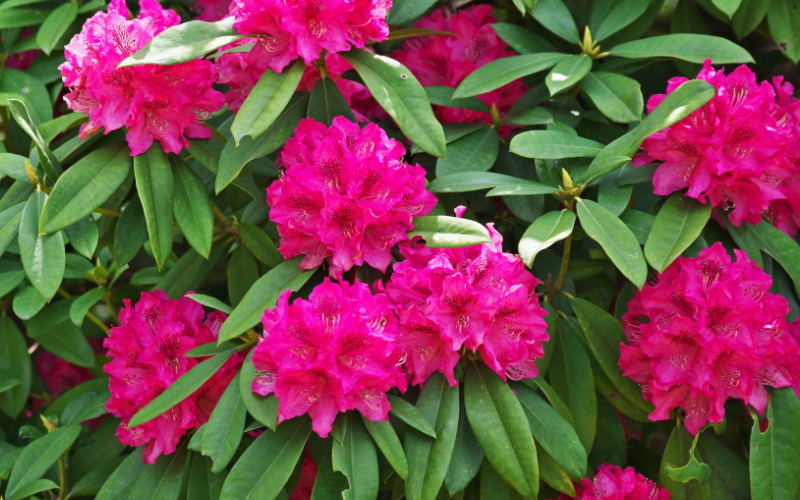
Pacific rhododendron (Rhododendron macrophyllum)
Image courtesy of Canva Images
Pacific rhododendron (Rhododendron macrophyllum), the state flower of Washington, isn’t as flashy as many of the named hybrids and has a somewhat lanky growth habit. Still, the pink to purple trusses certainly brighten the woodland garden. Provide it with some shade and moist to dry soil. Although it can be quite large, to 25 ft in the forest, it is typically much smaller with a little sunlight. Mine is roughly 5 feet tall at 10 years. In additional to the more manageable size, it will also produce more flowers with some sun.
The Youth Education Committee is a diverse group of volunteers. What unites us is a strong belief that children who connect to nature at an early age become lifelong stewards of the environment. Through our volunteer work, we hope to inspire youth to make this connection, to become lifelong learners of nature and to live lives dedicated to making the world a better place for all of us.
How can you help? Join our committee. Make a difference in children's lives by volunteering with the Youth Education Committee. Help students at a science fair make bird feeders to take home. Assist a committee member with a classroom presentation. Take children on a walk to see and identify birds. These are just a few of the many ways you can volunteer to make a difference.
We promise lots of fun and a feeling of giving back to your community. If you cannot make our meetings, you can still volunteer. Contact Mary Britton-Simmons at marybs98272@gmail.com to learn more.
Birding festivals are a booming. Several Washington State festivals have been held annually for more than 20 years. Birding publications a full of ads for festivals. Some birders love them and will travel around attending them over the course of a year. Some birders tend to avoid them. It’s a matter of taste. The festivals bring birders of all skill levels together to focus on an aspect of birding such as shrub-steppe habitat, a bird species such as the Sandhill Crane, or a migration hotspot such as the Olympic Peninsula.
Costs for festivals vary and some of the popular events have higher fees for the field trips and registering early is important. Typically, there is a registration fee and a charge for each field trip. Lodging and meals are not provided, and these add to the cost of attending a festival. Some festivals have camping facilities nearby. Most festivals offer field trips led by a local birder and limit the number of participants, so groups do not get to large. Most festivals run for a three-day weekend and may be worth a special trip to participate in them. The one-day festivals are smaller affairs and may be worth attending only if you are in the area already. The following 9 Pacific Northwest festivals are listed chronologically between March and June in 2023.
Wings Over Water Northwest Birding Festival , March 17-19, Blaine Middle School, Blaine, WA
This festival requires a registration fee and offers many free birding field trips and birding cruises for an extra charge. Guest speakers present on aspects of birding and often on seabirds. This festival is in its 20th year.
Othello Sandhill Crane Festival, March 24-26, McFarland Middle School, Othello, WA
The Sandhill Crane festival is in its 25th year. It is a large and popular festival that provides many workshops and field trips ranging in price from $20 for a half-day trip to $80 for premium photography trips. They provide bagged lunches for $20. However, general admission is only $12 and you can attend as many of the lectures as you want. Accommodations range from camping to bed and breakfast to hotels in Moses Lake, a 20-minute drive from Othello.
Tundra Swan Festival, March 25, 9:00 am to 4:00 pm, Camas Center for Community Wellness, Cusick, WA
This is a one-day event to celebrate the migration of Tundra Swans through the Pend Oreille River Valley. It is organized in conjunction with the Kalispel Tribe. If you are in the northeast Washington area at the end of March, it would make a vrey nice additional stop on your trip. You can learn about the swans and the Kalispel community.
Olympic Birdfest, April 13-16, Dungeness River Nature Center
This is another popular birding festival which attracts birders from around the country. In fact, most attendees live outside Washington. This festival is a partnership of the Olympic Peninsula Audubon Society, the Jamestown S’Klallam Tribe, and the Dungeness River Nature Center. It offers many field trips around the Northern edge of the Olympic Peninsula including the Dungeness Spit and a cruise around Protection Island. Field trips run about $30 each and some classes are $40. Special full-day trips led by famed Olympic leader Bob Boekelheide are $95 per person. It’s worth it. At this writing in early February, some trips are already sold out. This is lovely area for birding, and I recommend a visit in spring even if you don’t attend the festival.
Grays Harbor Shorebird and Nature Festival, May 5-7, Grays Harbor NWR, Hoquiam, WA
This is long-running festival that uses a do-it-yourself model. Registration is only $10. There are no field trips or presentations. Festival volunteers are available on the Sandpiper Trail at the Grays Harbor National Wildlife Refuge to assist with bird viewing. Festival volunteers also provide information on best birding times based on the Aberdeen tide charts. This tide schedule can be downloaded from the festival website and functions as a guide to birding spots around Grays Harbor and Pacific Counties. This is definitely a hotspot for shorebird viewing whether you participate in the festival or not.
Yakima River Canyon Bird Fest, May 12-14, Helen McCabe Park, Ellensburg, WA
This year’s 24th festival has the theme “Get Intimate with Shrub-steppe Habitat.” There is no extra change for field trips, which focus not only on birds, but also geology, sage country habitat, and a special event to get onto the Department of Defense Yakima Training Center, an area of protected sagebrush habitat. A DOD background check is required for this event. Some events require a payment, but the amount is not available without going to the registration page. This is a special and declining habitat in Washington and the Kittitas Environmental Education Network (KEEN) of state, county, federal, and non-profit organizations is committed to preserving it. The event kicks off with a bonfire on Friday night and goes on from there!
Leavenworth Spring BirdFest, May 18-21, Wenatchee River Institute, Leavenworth, WA
This festival is in its 21rd year and it all comes together around World Migratory Bird Day. The festival offers pre-festival field trips in the $8 to $25 range and many more trips on the festival days. Art workshops run $30 to $40. Historically, the festival has involved many members and businesses in the community and the brochure has been printed in Spanish and English. A youth art program continues to be a focus of the festival.
Meadowlark Nature Festival, May 19-22, Penticton, British Columbia
Information about the 2023 festival is not available at this time. However, the 2022 schedule is available on the website. Field trips cover a wide range of habitats from valleys to high elevation locations. Prices range from $20 or $30 up to $150 for birding in South Okanagan with Richard Cannings, co-author of Birds of the Pacific Northwest: A Photographic Guide, which I reviewed for Northwest Science. He is probably the most knowledgeable person about birds in British Columbia. This festival sounds like it would be a great introduction to birding in the Okanagan Valley in BC!
Dean Hale Woodpecker Festival, June 1-4, Creekside Park, Sisters, OR
This annual event accesses U.S. Forest Service lands on the Eastern slope of the Cascades in Oregon. Habitats include Ponderosa pine forests, riparian areas and high elevation meadows and lakes. Although the focus is on woodpeckers, field trips, which range from $20 to $45, seek out bluebirds, flycatchers, owls, and shorebirds. Register through the East Cascades Audubon Society website.
There are three other festivals in the PNW, but I could not locate any details about them. You might find better information in March.
Annual Harney County Migratory Bird Festival, April 13-16, Burns High School, Burns, OR
Annual Ladd Marsh Bird Festival, May 19-21, Ladd Marsh Wildlife Area, La Grande, OR
Tualatin River Bird Festival, May 20, Tualatin River National Wildlife Refuge, Sherwood, OR
If you want to go far afield you can locate birding festivals all over North America and beyond at the All About Birds website from Cornell Lab of Ornithology.
Enjoy spring birding wherever you decide to go!


