
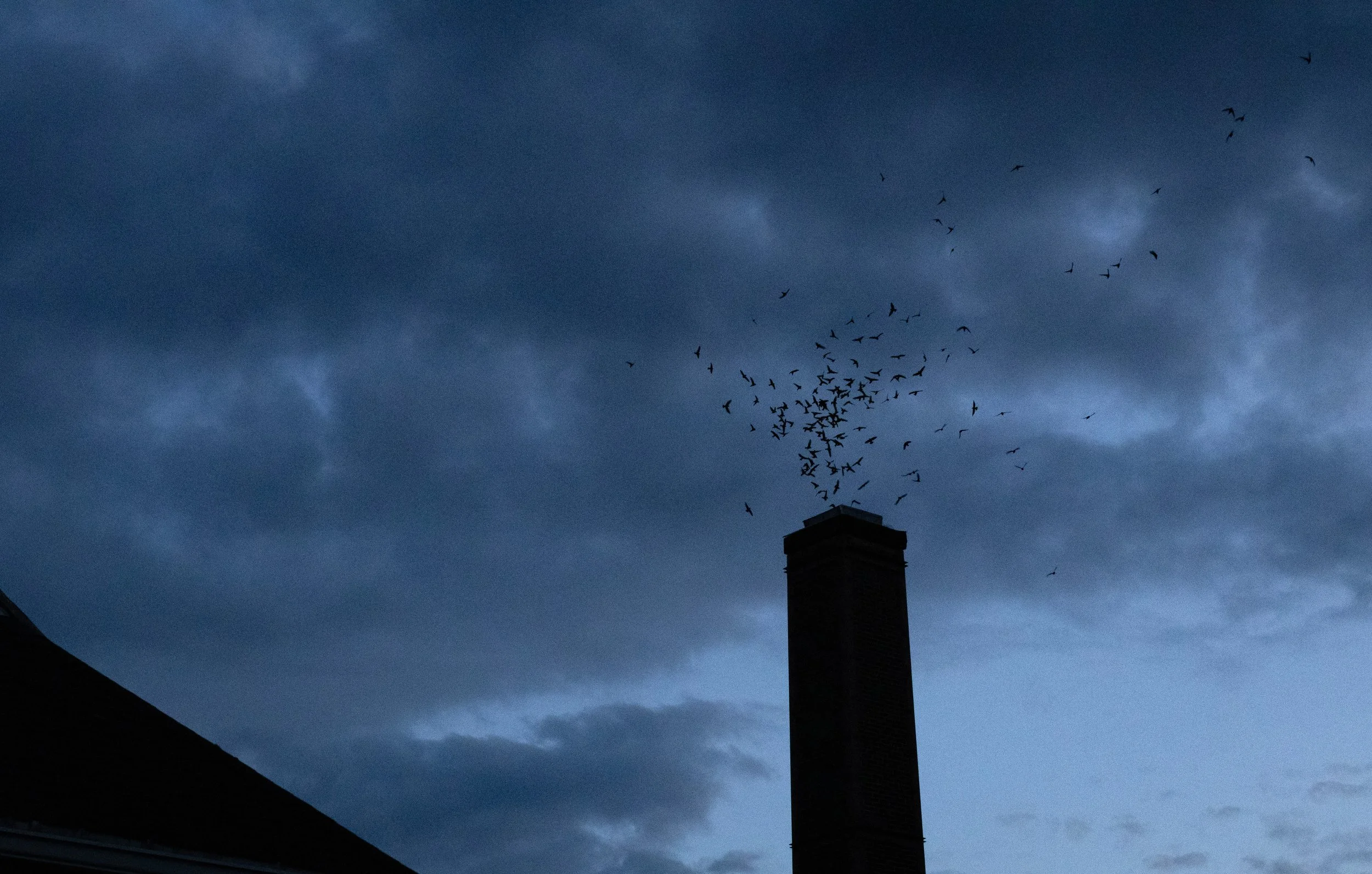
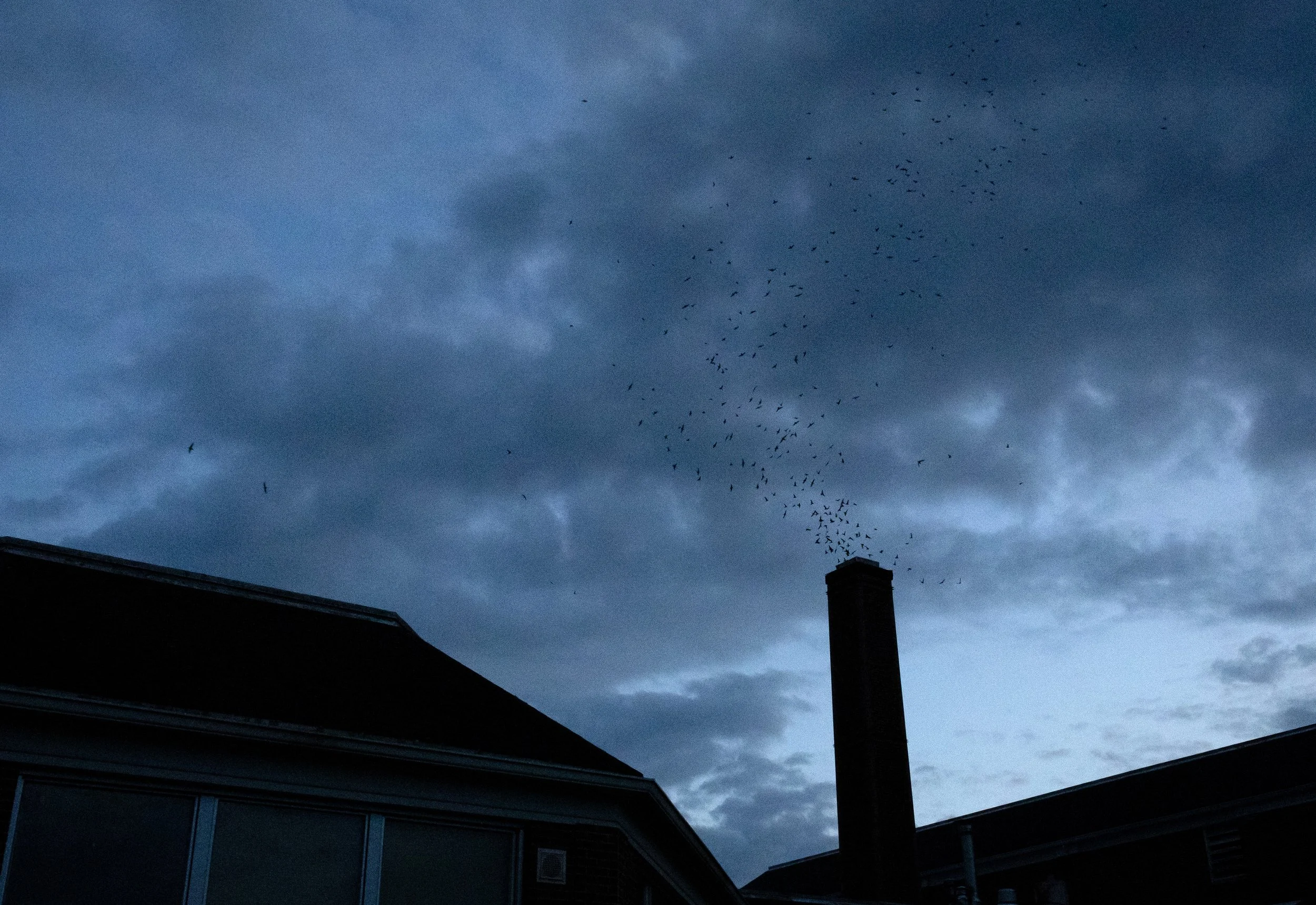
Vaux's Swifts descend into the chimney at Frank Wagner Elementary School in Monroe. Photo by Ian Shultz.
As the sun begins to set, small, agile birds flit across the horizon and coalesce into a single, homogeneous shape, swirling and spiraling in the air like a stippled black whirlwind. Without a visibly apparent purpose, they perform their spectacle before forming a vertical column angled directly for an old brick chimney, depositing a few birds into its depths before banking upward and repeating the descent, again and again, until only a few stragglers flit across the now-darkening sky—moving with far less direction without their flock. Before long, the sky is dark, and the Swifts are asleep.
For just a fleeting fifteen minutes around sunset on late summer and early fall evenings in Monroe, thousands of Vaux’s Swifts assemble above the historic brick chimney at Frank Wagner Elementary School and drop, one small, synchronized group at a time, into the brick shaft where they will spend the night.
Vaux’s Swifts roost communally in the hollowed-out trunks of old-growth trees and, as those have disappeared, in the chimneys and smokestacks that have been built in their place. The substitution has left the species remarkably concentrated: roughly a dozen large-chimney sites shelter about 90 percent of the migrating population, and newer chimneys, often lined with metal, are too slick for the birds to grip. Once Vaux’s Swifts select a certain chimney as their accommodation for their biannual migration, they are not guaranteed to return to that site—but with their options continually decreasing, it is all the more important to preserve the locations they do pick.
This is exactly what was going through local birders’ heads in 2007, when the chimney at Frank Wagner Elementary School faced potential demolition. The Monroe School District reasoned that while the schoolhouse on which the chimney was perched was still functional, the chimney itself no longer served a purpose and posed a safety hazard—an avalanche of bricks over the schoolyard could have been catastrophic. Tearing it down might have been an obvious solution.
The only case against it rested on the Vaux’s Swifts, who had called that chimney home twice a year for decades. Still, nobody had ever counted how many birds actually roosted there or how many would be affected by demolition.
So, to prove the birds’ worth, the birders counted them. Volunteers organized under the name Save Our Swifts, and retired middle-school science teacher Larry Schwitters began recruiting observers to watch chimneys across Washington State at dusk and tally birds as they dropped into their roosts.
The results of the count quickly settled the question, establishing just how much of the state’s Swift population depended on this one chimney—of the 183,463 documented Vaux’s Swift encounters at chimneys in Washington during the spring 2008 migration, 74% occurred in Monroe. On the evening of May 7th, Judy Alles counted an incredible 21,027 Swifts entering the Frank Wagner chimney—now believed to be the largest number ever recorded for the species when migrating northwards.
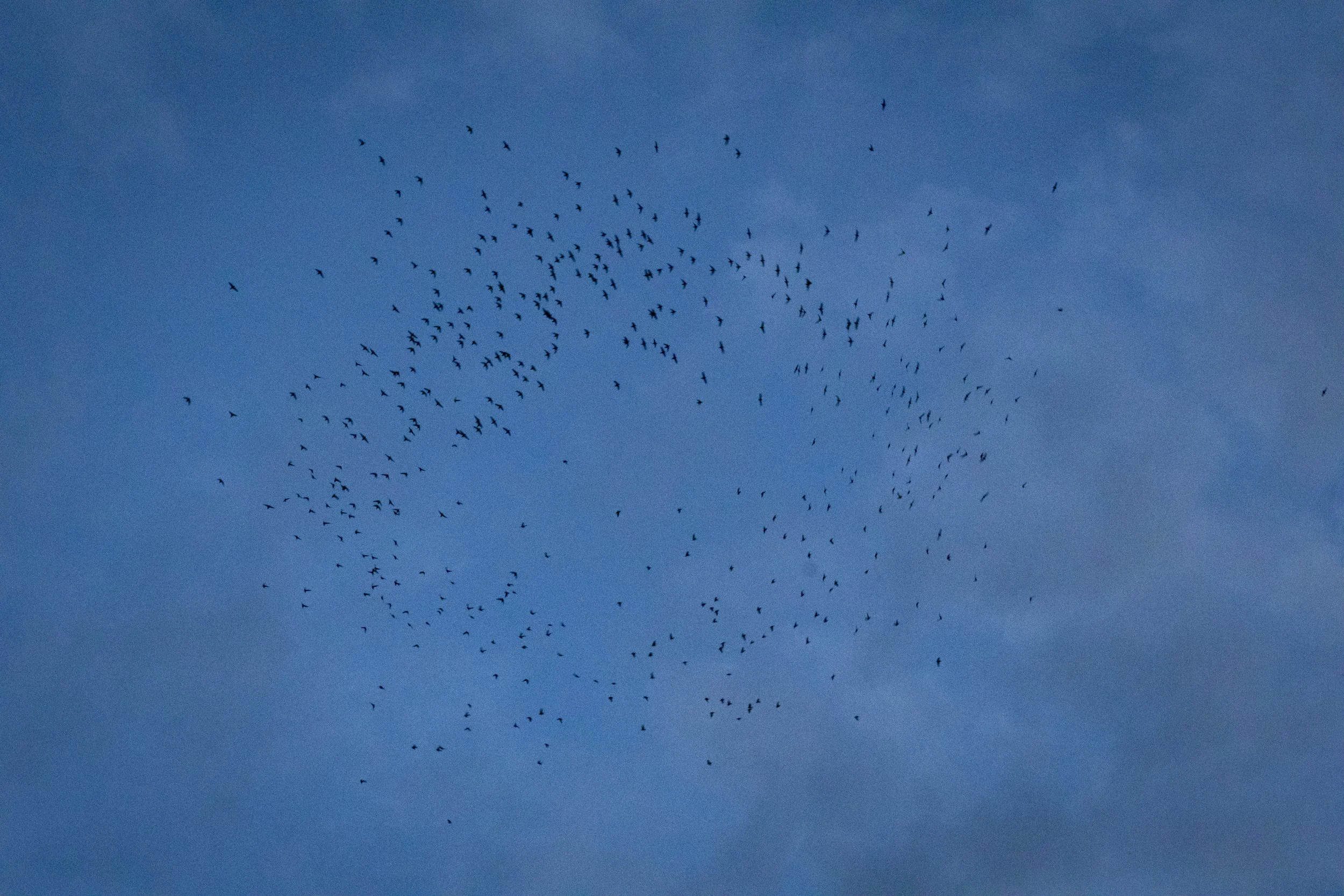
Swifts gather above the roost before dropping in. Photo by Ian Shultz.
With the chimney’s significance established, the Eastside, Pilchuck, and Seattle Audubon (now Birds Connect Seattle) chapters funded an engineering study that led to the chimney’s seismic upgrade just a year later, in 2009. Much of Eastside Audubon’s part in that effort was led by Jim Rettig, who was at the forefront of Save Our Swifts’ successful campaign to prevent the demolition. A Woodinville resident who joined the chapter in 1989, Rettig served as its president and sat on its board across multiple terms, later acting as Eastside Audubon’s liaison for Swifts Night Out. In 2012, the chapter named him its Environmentalist of the Year, recognizing him for more than two decades of leadership in habitat conservation and citizen science.
The chimney is now officially designated a globally Important Bird Area, and in 2016, Monroe named the Vaux’s Swift its official bird.
And, quite beneficially for the Swifts, the counting never did stop. The project that began as a local effort to save one chimney eventually grew into Vaux’s Happening, a volunteer survey that now spans much of western North America and has tallied over 31 million Swift sightings.
“Volunteers are the backbone of this project, and [are largely] the reason why we know what we do about this species,” said Brian Zinke, Executive Director of Pilchuck Audubon Society. “There’s very little in the scientific literature about Vaux’s Swifts, so the long-term data that our volunteers are collecting—from British Columbia to Mexico—are really helping create a baseline understanding of what the population looks like.”
That population baseline is especially important because saving a chimney does not necessarily mean it will remain a roosting habitat forever. From the late 1980s through 2024, thousands of Swifts roosted each September in the chimney at Chapman Elementary in Portland, drawing crowds of up to three thousand people a night. In early September of 2024, the birds dispersed and never again returned; in 2025, they instead roosted at other chimneys around the city. No clear explanation has emerged—the birds simply decided to leave, just as Swifts migrating elsewhere along the Pacific Flyway have been documented doing before.
If the birds can abandon a chimney at any time, then identifying all their possible roosts matters all the more—and on the Eastside, that knowledge quickly runs out.
“We don’t have any known, active roosts in Eastside Audubon’s territory,” Zinke said. “We have a very active one just outside the area in Selleck [a former lumber-mill town in southeast King County], but it seems likely that we’re missing some. If you know of any old chimneys please let us know, we’d love to have help locating more roosts.”
The Eastside is not short on candidates. Any large, open brick chimney could be a roost, and Bellevue, Kirkland, and Redmond all still have their share of old brick chimneys standing atop rooftops that nobody has thought to watch at dusk. Discovering even one active Swift roost would add a new site to a map that volunteers have spent nearly two decades filling in.
Contributing is easier than it might sound. Volunteers count the Swifts at the Frank Wagner chimney roost throughout migration and submit their numbers to Vaux’s Happening, where the counts appear on a live dashboard. Anyone can do the same—those interested can check out https://www.vauxhappening.org/.
And to see it in person, Swifts Night Out returns to Monroe on Saturday, September 12th, running from 4:30 P.M. until dusk at 639 West Main Street, with a presentation by Larry Schwitters at 6 P.M. For more information, click here: https://www.pilchuckaudubon.org/swifts-night-out
The last birds enter the chimney at dusk. Photo by Ian Shultz.
Happy birding!
Resources:
- Report counts to Vaux’s Happening: https://www.vauxhappening.org/
- Check out the live Swift count dashboard:
https://audubon.maps.arcgis.com/apps/dashboards/7c5ccf7e791c459ebc77047e834f0e7f#
- Check out Swifts Night Out: https://www.pilchuckaudubon.org/swifts-night-out
Ian Shultz is a high school student, Youth Board Member at Eastside Audubon, and bird photographer who most recently won the Youth Prize in the 2026 Audubon Photography Awards. You can see his work at shultzphotography.com.